

✪ Curation as Authority Infrastructure: How to Build a Body of Work People Depend On - #83
Most experts compete by producing more. The ones who last build something readers come back to. Here is the model for moving from a voice people read to infrastructure people rely on to find their way

First, with “✪ Why Curation Is Becoming the New Trust Strategy: The Data Behind It - #81” I showed, with data this time, that curation is indeed becoming the trust strategy for experts.
Then, with “✪ The Trust Node: How to Structure Your Expertise So AI Agents Can Find, Trust, and Cite You - #80” I showed how to structure your work so AI agents can route through you.
This new essay answers the question: how does curation stop being a stream of nice posts and start becoming knowledge infrastructure, building authority in your field over time?
The Radio and the JukeBox
When I was younger, before the Sony Walkman came to be, if you wanted to hear some music outside the home, FM radio was the first option. You would tune in the first station playing music and hope for the best. Some tracks were great, some sucked, some made you want to tune in to another station. The main limit was that you were always in a passive mode. Someone else was choosing for you. The only thing you could do was cross your fingers and hoping for the best.
A better option was to get into a bar or coffee shop where there was a jukebox. These were big - dishwasher-sized - shiny, colorful boxes that allowed you to put in a few quarters and select the music hits you wanted to listen to, in your specified order. Inside it there was a good selection of the music of the times, well organized in one form or another, from which you could draw a little customized musical journey. 100% active mode. The juke-box offered the infrastructure and you navigated and played through it.
Today’s indie authors and publishers are mostly like FM radio stations. You can’t really predict what they are going to be writing next.
Today’s jukeboxes are those trusted guides who choose a different editorial strategy. They don’t rely on freshness, novelty and originality. They rely on comprehensiveness, focus and usefulness by mapping and curating a well-defined territory.
Why?
Because a map is different. You build it once, you keep it current, and every time someone uses it and it proves reliable, they trust it a little more. Note: Your map doesn’t compete with the next emerging idea. It maps it, it absorbs it, making the map more useful as time goes by and you map more.
This is the whole thesis of this essay: Your authority comes from the map you build and keep current, the one other people use to stop wandering, start exploring, and get to know your territory better. The more they use it, and the more it fulfils their needs, the more they trust it.
Building such a map means curating an information space. My claim is that by doing so, you can significantly increase your credibility and authority in your field. The reason is that as you move from being a voice, a source of opinions, reviews and ideas, to a focused hub people use to navigate and better understand a field, you structurally become a trusted source for humans and AI agents that route through you.
Table of Contents
1. Why Producing More Content Quietly Stopped Working
For most of my career, producing content was the hard part, so doing it well was proof of something. If you wrote a good article, the effort itself was proof that you knew something about your field.
Today a good article no longer proves the author knows the field and did the work. A well-written, professional-looking essay no longer proves the author understands the subject. When the cost of acceptable-looking content drops to almost nothing, the old assumption that “well written” also means “well thought out” stops being true.
So if you keep competing on output, you are racing AI machines at the one task they were built to win.
The way off this treadmill is to compete on something AI can’t create: a structure of selected resources, tools and frameworks that gets deeper and more connected over time.

2. Content and Infrastructure Are Not the Same Thing
Here is the key distinction to keep in mind, as almost everything I claim follows from it.
Content expresses. It gives an opinion, an update, a take, a piece of advice. It is judged on its own, each time, as a performance.
Infrastructure organizes. It maps the territory, names the players, shows how things connect, and helps a reader move through complexity without drowning. It is judged by how reliably you can return to it.
For example, a newsradar you maintain for two years is infrastructure. A comparison table you keep current is infrastructure. A reading path that takes a beginner from confused to capable is infrastructure. A directory of the best tools in your niche, dated and vetted, is infrastructure. None of these can be considered a one-off post. Each one is a thing people bookmark, return to, and quietly integrate into how they work.
So the natural question one should ask before starting to write anything should be: Am I adding another random song, like a radio station would do, or am I becoming a juke-box that people can use and return to, to find what they’re looking for?
A song on the radio plays, and then it’s gone. Songs inside a jukebox can be played over and over. It is you who choose what to play from that big catalog. The jukebox is a music map and you decide how to navigate through it. As such it is music infrastructure, like Spotify, YouTube or any other music platform, when you control what plays next.


3. The Three Kinds of Authority
In my experience, there are three stances an expert can take, though they are not equally valuable.
Voice authority says “I’m smart, read what I think.” It lives in your personality and your prose, and at its best it’s magnetic. You read Steven Johnson’s Adjacent Possible for the turn of his mind, not the news in it. Daniel Pink has sold millions of books on the strength of one clear thinker reframing how motivation and work actually function. DAN KOE built a large following on essays about focus and the creative life that only sound like him. The catch is that the form is just words and a stance, the most crowded corner of the internet and the part an AI model imitates most easily. A thousand newsletters reach for it, and the average one now reads like something any AI machine could have written, because that’s indeed the case.
Curation authority says “I filter well, trust my selection.” This is a real step up. Your taste becomes the product, and people start relying on what you choose to put in front of them. Jason Kottke has run kottke.org since 1998 on the belief that a good link beats a loud opinion. Mapu’s Instead of Doomscrolling sends a weekly roundup of what’s actually worth your time to a fast-growing readership. Shaun Usher turned a knack for finding remarkable old letters into Letters of Note, a collection people return to for years. You follow them for one thing: their judgment about what deserves your attention.
Infrastructure authority says “I organized the territory, route through me.” This is the posture almost no one reaches, and it is the one that holds. Michel Bauwens built the P2P Foundation wiki, a reference on the commons that researchers cite and route through. Robert Scoble spent thousands of hours building curated lists of the AI industry that now feed a daily news service, a structure people and even AI agents use to read the field. Jeremy Caplan’s Wonder Tools is a maintained, vetted reference of tools people come back to instead of searching from scratch. When people have built your structure into their daily work, leaving it costs them something. You stop being a writer they enjoy and become a resource they can’t easily replace.
The first two stances are where almost everyone competes today, and they’re the two AI has just flooded with its content.
The third is the one I believe has the longest shelf life, and it represents the core claim of this article: Move from a voice people read toward creating a knowledge infrastructure people rely on to find their way.
Read more about this here:

4. Why Infrastructure Is the AI Antidote
Let me clarify though, why I am so stubborn in claiming that knowledge infrastructures create such value and stand so clearly apart from AI-generated content. Too many times I read “AI can’t do it”, but with little or no evidence supporting these claims.
Here’s what I am observing: An AI model can replicate polished prose in seconds. What it cannot replicate is a compiled, cross-referenced, consistently maintained body of choices with visible roots and traceable sources. The value in that body of information is not in the literal text that is inside it. It is in the accumulated decisions of the person who has maintained it: what they included, what they dropped, why this connects to that, and how the whole thing held up and improved after a year of maintaining it.

There is also another important reason. Choices made over time are crystallized intelligence, the pattern library you’ve built from decades of seeing what works and what only looks good. An AI can generate a hundred plausible options. But an AI cannot know which three of those 100 actually apply to your specific context and audience, because it has never lived through the actual risks and consequences.
When your infrastructure makes your judgment visible, choice after choice, you are showing the one thing that can’t be faked at scale.

So the real point of distinction is your ability to show how you choose, how you select, how you think, in a clear, structured and intelligible fashion.
5. What Makes a Map Trustworthy
A map is only worth following if the reader can trust the cartographer.
There are two elements that make the cartographer and his map trustworthy, even though most experts rarely use either one.
a) Paradata
Show your process, not just your final choices. How you found each item, what you tested, what you rejected and why, when you last checked. I covered this fully in ✪ Build Credibility and Trust by Using Paradata: The New Signature of Serious Expertise - #66. This stuff matters more every month, because giving opinions is now super cheap while showing the reasoning behind your choices is proof that a human did the filtering. “I monitored this field daily for six months, tested the top 30, dropped anything that needed more than 30 minutes to set up, last verified in June” has a different kind of weight than giving some personal advice or opinion on the topic you chose for the day.

b) Compound Credibility
A single article stands alone and is judged alone. A curated selection adds to a pattern. Make 50 choices over six months and your standards become visible: what you value, who you serve, how consistent your judgment is. That pattern becomes something similar to a signature, as it defines the way you think, choose, and take a stand. And the more transparent and consistent it is, the more it builds trust over time. The practical strategy is to stop publishing conclusions by themselves, isolated from the rest. Attach the trail. Connect to the rest of your work. Draw lines between the dots until a figure shows up. The reasoning, what you choose and what you discard, is now your key asset.

6. Real-World Examples
Maria Popova has spent more than 15 years building The Marginalian. Any single essay of hers is good, but the real asset is the archive itself: thousands of pieces, themed and cross-linked, searched, revisited, and returned to for years. People don’t read one post and leave. They use her whole body of work like a library. That archive is infrastructure, and it is why her authority didn’t decay the way a stream of hot takes would have.
Ben Thompson built Stratechery on a different kind of structure. He developed a small set of durable frameworks, Aggregation Theory chief among them, and applied them to case after case. His readers don’t come for one prediction. They come because they have internalized his lens and use it to make sense of the whole industry. The framework is the infrastructure, and people route their understanding of tech strategy through it.
Techmeme is the same idea in feed form. Gabe Rivera built a human-edited dashboard of what matters in tech right now, and it became the default page an entire industry checks each morning. No single headline is the product. The maintained, judged feed is. You can’t reproduce that by writing faster.
Kevin Kelly has run Cool Tools for more than 20 years, a curated catalog of the single best tool for any given job, each recommended by someone who actually uses it. It never tried to be a magazine. It’s the reference people reach for when they need to decide what to buy or use, and it grew into a cult following and a best-selling book. He didn’t out-write anyone. He built and kept current a catalog people route real decisions through.
Four different shapes: an indexed archive, a repeatable framework, an edited feed, a living directory. Each one is curation that hardened into infrastructure, and each earns a kind of trust a faster content machine can’t touch.
You don’t have to copy any of them. You have to decide which shape fits your field and your temperament, build the first small version, and keep it alive.
Inside The Full Curator’s Format Library: 25 Formats That Build Expert Authority Without Writing - #72 you’ll find a menu of curated editorial formats to choose from.
And if writing is really not your main dish, check here:

7. Knowledge Infrastructure Monetization
Building that kind of structure is also the path to getting paid, and the proof is not abstract.
Pieter Levels runs Nomad List, a curated and constantly updated directory of cities for people who work remotely. It’s a one-person business with no outside funding, and he has reported openly that it earns millions of dollars a year. He didn’t out-write anyone. He built a structure people pay to rely on.
And when the New York Times went looking for a foothold in product recommendations, it didn’t start a review blog. It bought Wirecutter, a curated recommendations site, for about $30 million in 2016. What it paid for was the accumulated judgment and the maintained structure, not any single article.
The mechanism underneath both is the same. Early infrastructure earns free visibility and trust, because you are showing you have judgment. Mature infrastructure earns money, because once your map is built into how someone works, switching away is costly.
From there the revenue is ordinary and well understood: paid access and premium tiers, sponsorships, affiliate income, advisory and done-for-you work, products built on the trust you’ve banked.
I’ve spent three years documenting these models curator by curator in my Curation Monetized articles, and the pattern holds. The structure earns where the disposable post never could.
For me this is just my original Sharewood Formula (2010) doing its work, the four-step arc I've taught for years: find your position, build authority by sharing real value, grow a loyal following, then earn through the products and services those people actually ask you for.
Infrastructure is the engine of the second step, and it's what makes the fourth one arrive on its own. The map you build to help people is the same asset that, over time, lets them hire you without you ever having to pitch.


8. Final Recommendations
The explorer who comes up with a super clever idea is easily buried under next week’s noise. But the one who drew the map an entire field uses is still going to be there, as useful as before, a few years from now.
The timing has rarely been better, but for a reason I wouldn’t have been able to predict just a few years back. AI agents and bots now make up most of the visits to the web, about 57 percent as of early 2026, and the share keeps climbing. Now when we search, we send out bots and AI agents who do the digging and research for us.
But what few have started to notice is what those machines reward is exactly what a knowledge infrastructure is: structured, attributed, maintained judgment they can trust and return to.

So the same thing that makes a person bookmark you is now also what makes an AI agent cite you. As Sari Azout puts it, in an age of overload “knowing where to go and what to do is the currency.” Though most experts have failed to notice, there has never been a better time than today to become such a trusted information source in your field.
If that sounds like cold, mechanical work, remember where the word comes from. To curate is from the Latin cūrāre, which means to care, to attend to, to look after.
Building a knowledge infrastructure is the most practical form of care you can offer the people in your field who are drowning in noise. You go ahead of them, you separate what’s worth their attention from what isn’t, and you leave a path they can walk on and trust.
This is in my opinion the work worth doing before anyone pays you for it, while also being the very same reason that they eventually will. So, if I have been able to clarify the relevance of this communication strategy and you can see its deeper meaning, my gentle advice is: start to care.
Put yourself in the shoes of your audience and their pressing needs and frustrations. What kind of resources, if maintained over time, would best help them resolve their key issues?
9) Where To Start: 10 Practical Ideas
Fascinated by this idea but confused about where to start? Here are some basic infrastructure ideas that you can start building now:
A collection of methods or techniques to resolve one of your audience’s key frustrations with actual references and examples of people who have already successfully used them.
An updated catalog of the best tools and apps that address a specific need, with notes on when to best use them.
A list of the top experts, trusted advisors and analysts in your field, accompanied by your personal evaluation.
A roundup of their critical viewpoints on a hot, contested issue in your sector.
A limited selection of books (ebooks, videos or tutorials) that you have read and highly recommend for newcomers to your field.
A learning path built around top-level articles, podcasts, videos and academic papers from qualified authors to learn most key foundational topics in your field.
A newsradar à-la Techmeme covering your very specific field of focus with the latest and most relevant news. See also Robert Scoble’s Aligned News as well as Joshua Parkinson’s, This Week in Social Media.
An archive of the best and worst examples of successful work in your niche, with clear explanations of what makes each one worth paying attention to.
A framework that brings together a small set of methods, techniques, practices, or prompts that focus on resolving a specific problem.
A categorized directory of the best information sources in your field, including the top newsletters, social media channels and feeds that anyone with serious intentions in your field should follow (while providing a clear reason why).
Build a small, unpretentious first version. Publish it without promoting it. Then, invest 20 minutes a week to add more detail and relevant info. In a few months you will have something unique, valuable, and worthy sharing publicly.
Maintaining it over time is the key point. That’s what turns any post, article or essay into infrastructure, and infrastructure into authority that compounds over time.
References
Floridi, L. (2025). “Distant Writing.” Philosophy & Technology
Rodrigues, T. V. (2026). “The Apt Curation Model: An Epistemic Virtue Theory of AI-Assisted Authorship.” Philosophy & Technology
Makrehchi, M. (2025). “Three Lenses on the AI Revolution: Risk, Transformation, Continuity.”
Cloudflare bot-traffic data, reported by Tom's Hardware (2026): bots and agentic AI at 57.4% of web requests versus 42.6% human, the first time bots passed humans online
Sacra, Substack figures (2025)
Paradata
Intent / Why: I published this essay for one specific reason: For many years, starting more than 20 years ago I’ve argued that curation builds authority. In #81 I finally backed it with data, and in #80 I showed how to structure it for AI agents.
But still, I did not have one solid reference piece on it, giving a stable foundation to this key claim I keep returning to. Even worse, I had no clue that this was the case, and had no way of uncovering it without doing some proactive investigation. As a matter of fact, I could have written for a few more years, without realizing that my content library had this glaring gap, had I not started interrogating my personal content knowledge base (Karpathy’s LLM-wiki concept - ✪ From Second Brains To Compounding Intelligent Knowledge Bases - #76) that I had started building a couple of months ago.
Having a second brain, a personal knowledge base or some other form of archive of all your published content, allows you to leverage AI to dig through it and to uncover lots of interesting things that would otherwise go unnoticed.
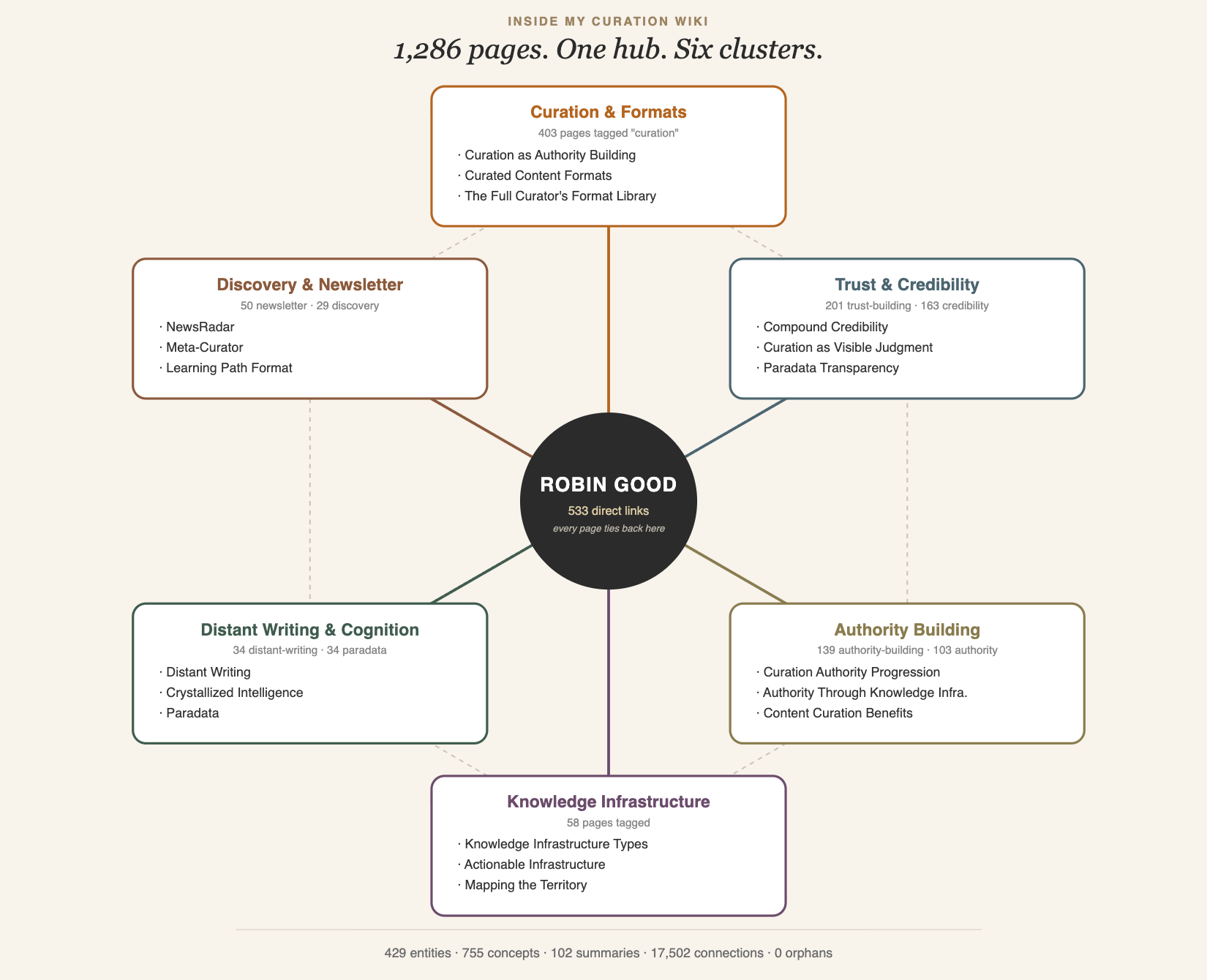
Process: It all started by putting to good use The Curator app - an open-source, personal knowledge base, developed by Dr. Tali Režun - which I have been feeding with each TRUST-able article I have ever published, since I installed it at the end of April. It now has 1,286 wiki pages, 429 entities, 755 concepts, 102 summaries, all interconnected. It is a navigable, structured and queryable information space that holds in an organized, organic fashion all of the concepts and ideas I have published so far in this publication. The entire space is viewable (and editable) through Obsidian and it can be searched and interrogated via its own Claude MCP.
As the knowledge base grew, I started to see how the different topics I wrote about actually connected and which were the key areas where I had written about the most. I could see all of the key concepts that make up my “world” around trust, authority and credibility for independent knowledge workers. And as the knowledge base grew, I started to see useful connections that I had not considered, as well as parallels between topics that could superficially appear as totally disconnected.
But, of the many interesting things you can do when you have such a knowledge base, the one that initially drew most of my attention was the ability to rapidly identify “holes” in my universe. That is, topics or ideas I have often referenced and tacitly alluded to, but for which I really have no published reference piece yet. In other words: like in today’s article, I may often allude to how X is important for Y, but I have never written an article that clearly explains why X is really so important for Y.
And yes, one of my biggest “holes” was the very topic of this article. I had Claude run a “demand versus supply” scan across the knowledge base to find the ideas I reference most often but have developed least, and “curation as authority infrastructure” came out on top by a wide margin, fed by 14 core concept pages and 71 of my own past articles.
I needed to have an article that brought together all of my claims and thoughts on this front in a structured, well-organized, referenced and case-supported fashion.
So, once the specific topic had been identified, I asked Claude to analyze all of the articles written so far, gather my claims on this front, and pull evidence, real-world examples and logic from everything else I had saved, collected or published in my other pubs or Substack Notes. The content and information were all already there, what was needed was a way to pull it together from different sources (TRUST-able articles, my Substack Notes, Curation Monetized articles, and stuff I saved inside Sublime) and structure it into one coherent piece.
That’s what I asked Claude Opus 4.8 to do for me. I asked it to draft an article, following my voice and writing rules, that would clearly explain my position around curation and trust, while illustrating it and supporting it with serious evidence.
From here it was all downhill. Tedious, long, very time-consuming, but rather straightforward. Once Claude had provided me with an initial structured draft, my work started. I reviewed and adjusted structure and order. I dropped useless, repetitive sections. I reported weak parts and examples that were not in line with my views and too disconnected from my audience. And then, little by little, I rewrote the best parts of the original AI-generated draft by hand.
I then dedicated time to checking and editing each and every section title, I used the wise winnowing method to arrive at a final title-and-subtitle combo, from more than 30 options, by using both ChatGPT 5.5 and Claude Sonnet 5. I do this every time and I have started to notice that - as it should be, more often than not I am the one ending up deciding on it, sometimes in sharp contrast with AI recommendations. Since I know what I want, I end up revising and changing lots of AI suggestions, which are useful anyway, as I use them as a useful comparison point, fully leveraging the Bowerbird Method benefits.
I finally worked on the cover, for which I always follow the same process: I submit the article for which I need the front image to both Claude and ChatGPT and ask them to suggest alternative design ideas (in writing) using symbolism, metaphors and situations from real life, not made-up universes, sci-fi or impossible imagery. I want my cover images to be grounded in reality, to be centered around humans, and to have a classical, timeless feel. Once I spot two or three visual ideas that fit the title and content of the article, I start prompting ChatGPT Image 2 to execute 4 design alternatives for each one. From there I select the key idea, and keep prompting and refining the framing, light, position of the subject until I have it as I want it.
Finally I use again ChatGPT to check all of the article text for grammatical errors, misspellings, overlooks, badly constructed phrases I may not have caught yet. I don’t blindly execute them, considering each one carefully to decide whether it is really needed and appropriate.
Time:
Research and demand scan of the knowledge base: 0.5 hr.
First outline drafting and editing: 0.5 hrs.
Revisions, analysis and changes: 1.5 hrs.
Manual writing: 2 hrs.
Paradata: 1.5 hr.
Cover design: 1 hr.
Formatting: 1 hr.
Links and references: 1.5 hr.
Grammar and general text verification and corrections: 1.5 hr.
Title and subtitle refinement: 0.5 hrs.
Total apx time: 11.5 hrs.
Tools:
The Curator app + My Curator MCP (personal knowledgebase)
Sublime (private digital garden where I save ideas, passages and quotes)
Claude Cowork w/Opus 4.8 / Sonnet 5
ChatGPT 5.5

Cover image: The map and the mapper: The curator and the jukebox - Concept & Design by Robin Good, executed by ChatGPT Image 2
Learn More About Curation
I help experts and consultants who are building a new online career gain the authority, credibility, and visibility they initially lack.
I do this by teaching them how to become trusted curators in their area of expertise.
For this purpose I’ve created a focused 55-minute video workshop that walks you through:
Why curated content formats are so useful for building credibility and authority
When to use them and what requirements they have
An updated list of real-world examples of curated formats at work
The specific tools you need to curate
The actual key steps that transform researching and writing into curation
The 11 typical mistakes novice curators make
One-to-One Audit & Strategic Advice
For experts and consultants looking for ways to:
a) Create Value and Build Trust
I help you identify and master your own personal ways to gain authority and create value by curating insights, research, news, resources and tools in your field of interest.
b) Improve Credibility and Trust
I review your content, positioning and goals to identify the best editorial strategies to build trust and credibility around your focus.
c) Positioning and Personal Branding
I analyze your market positioning to identify key strengths and weaknesses. I help you redefine a strategy to differentiate yourself from the competition while increasing the practical value you bring to your readers.
Available in two tiers: one for those just starting, and one for those who have been publishing for more than a year but are not seeing results.
Follow a path with a heart.
The time is now.

From Koh Samui (TH)
Robin Good