


This is the third online resource I built by leveraging the content of my own LLM-wiki knowledge base.
1st resource: “What I Think” - small web resource showing what I think and who influenced me.
2nd resource: “25 Ways To Share Your Expertise (without writing another article)”
3rd resource: a unique web app that allows you to analyze, evaluate and score your personal website in terms of “visible credibility”. How much of your expertise is actually visible and verifiable? What other key signals are there that you are a credible, honest and competent person in your field? What’s missing or could be improved?
Trust Grader
Measure how credible and trustworthy your personal website appears to someone (human) checking it out for the first time.

*As of now Trust Grader is 100% free and accessible to everyone.
**If you find it useful, please help me support the small but tangible cost of running these new apps I am building by becoming a supporting subscriber.
Trust Grader is a free tool that uses 34 checks to assess - in less than 2 minutes - how clearly your personal website presents signals of credibility. The criteria grew out of my more than 20 years of experience evaluating websites and people’s online credibility. I then reviewed them against available research and documented the evidence and rationale for each one.
How I Got Here
This tool had been on my list of possible projects for more than a year. I wanted a way to assess how a consultant, expert, advisor, journalist, coach or artist comes across to someone visiting their website for the first time. For independent professionals, that first impression may influence whether a visitor decides to follow, hire or collaborate with them.
How one appears and is perceived by other humans online is of primary importance for those who rely on their credibility, authority and trust to establish their authority, to grow their audience and to generate revenue.
If you work independently as a consultant, expert, advisor, journalist, coach or artist, I believe it is worth having a personal website.
For many years, I maintained one myself, often using it as a landing page for my services and offers. But around the start of this decade, I began to question how much it mattered. Perhaps, I thought, a strong presence on platforms like Medium or Substack could be enough for an independent author.
I remember expressing that view in a comment to Mark Schaefer, whose work on marketing I have followed for years. As I recall it, his response was emphatic: he believed an independent author should have a personal website, and that nothing could replace it.
I remained skeptical.
My view has since changed again. I now believe a personal website is a valuable investment for independent professionals. It gives people one place to see who you are, what you do, why you do it, and what supports your claims. It also gives you more room to present your work and link to evidence than a typical social profile does.
I have not found a scientific study that directly tests whether simply having a personal website increases an expert’s credibility. My belief is based on experience and observation, not a proven causal finding. And a website is not a requirement for visibility or success: people build successful careers through social platforms and other channels.
Still, when someone is considering you for work or collaboration, a clear, current and verifiable website gives them one place to learn about you and check your claims. I suspect this can strengthen your visible credibility, especially when people are comparing professionals with similar backgrounds. I haven’t found research that directly measures this effect, so I offer it as my belief, not a proven result.
A well-organized personal website may also make it easier for search engines and AI systems to find consistent information about you. Trust Grader currently assesses the page as a human visitor would experience it. It does not evaluate how machines read or rank it.
I had written about many of these signals in earlier articles.


Two and a half years ago, I turned some of those ideas into a Credibility Scorecard for reviewing a personal website. It was a useful first step, but using it by hand was slow and difficult to apply consistently.
I thought building a faster, more consistent tool would be too difficult, and that assessing credibility would always involve too much subjectivity.

I was wrong.
How I Started
On Wednesday, September 23, I returned to this idea for perhaps the third or fourth time. This time, I asked Claude to help me explore how the tool might work. I gave it access to my knowledge base and articles, and asked it to find what I had already written about recognizing credible, trustworthy people through the evidence they leave on their websites.
Claude surfaced criteria I had developed over the years and invited me to review each one in light of what I knew now. I reconsidered their relative weights, removed one or two, and added a few.
At that point, I expected at most a design prototype. Instead, Claude returned a rough but fully working web app that did what I had wanted to build for a long time.
What surprised me was not the app itself, but how quickly an idea I had thought too difficult could become real once I precisely knew and could articulate what I wanted.
The Hard Part
In fact, I couldn’t quite believe my eyes.
Claude came back with a rudimentary looking but fully working web app that, albeit still imprecise, did exactly what I had been dreaming of building for a long while.
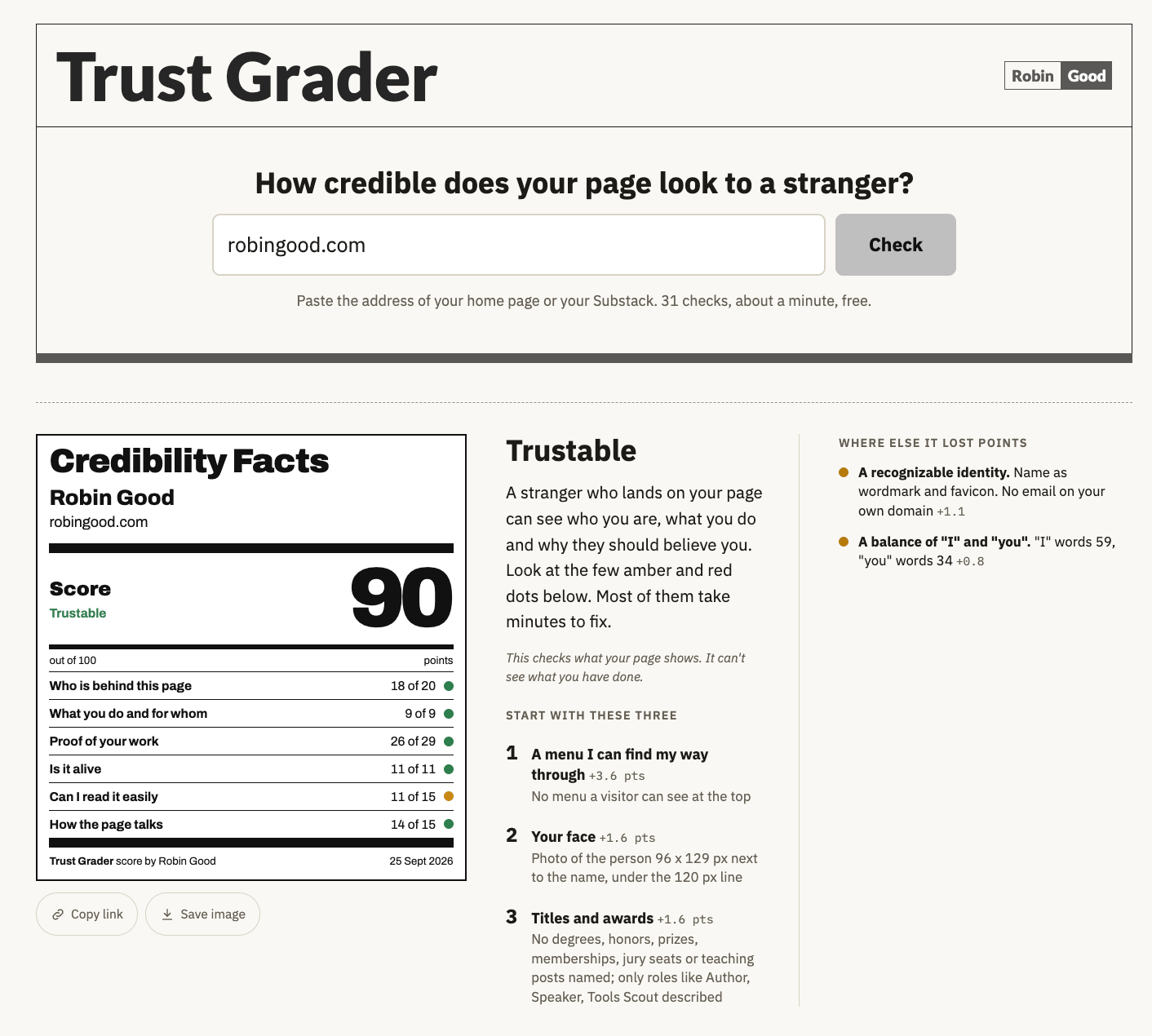
I was more surprised than I could had ever anticipated.
Not because the tool did something out of the ordinary, but because I felt again the gap between what I think is possible or complex to do and how easy it has become to transform it into reality with AI, once you know precisely what it is that you are after.
I started to see what had changed. With AI, I could build something I had assumed was beyond my reach. Building it still took work, but deciding what to build, who it should help, and what would make it useful was definitely harder. Those choices drew more on my experience, judgment and knowledge than writing the code did.
The difficult challenge is not anymore in the building of something but in deciding what is appropriate to build.
And while this statement may seem to imply that things are getting somewhat easier and less challenging, it is exactly the opposite.
Choosing what direction to take and understanding what is truly needed requires a lot more critical thinking, experience, know-how and insight than to code a new app or design a new website.
App Design Approaches
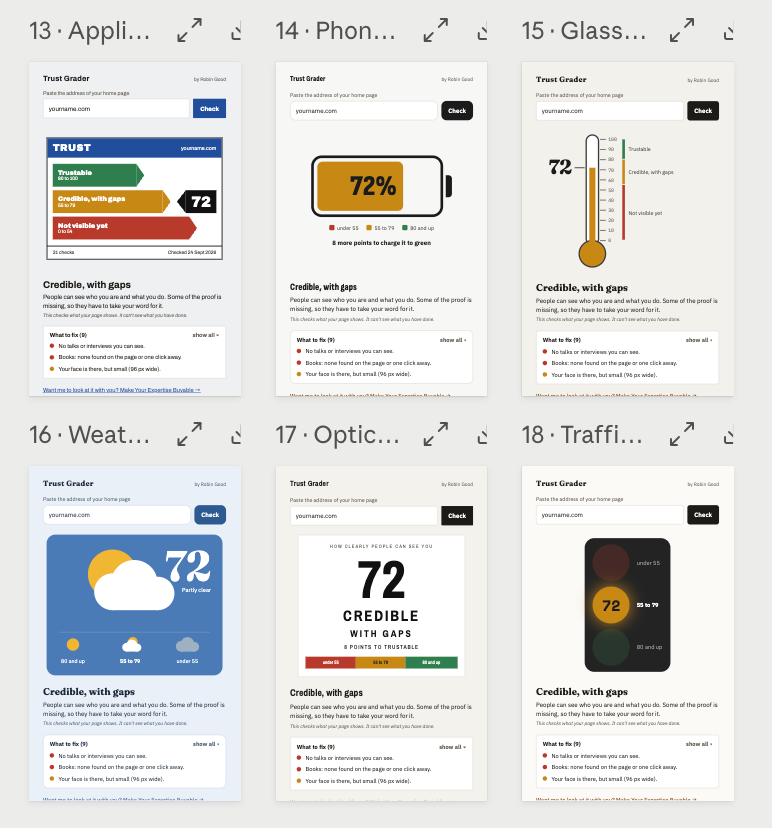
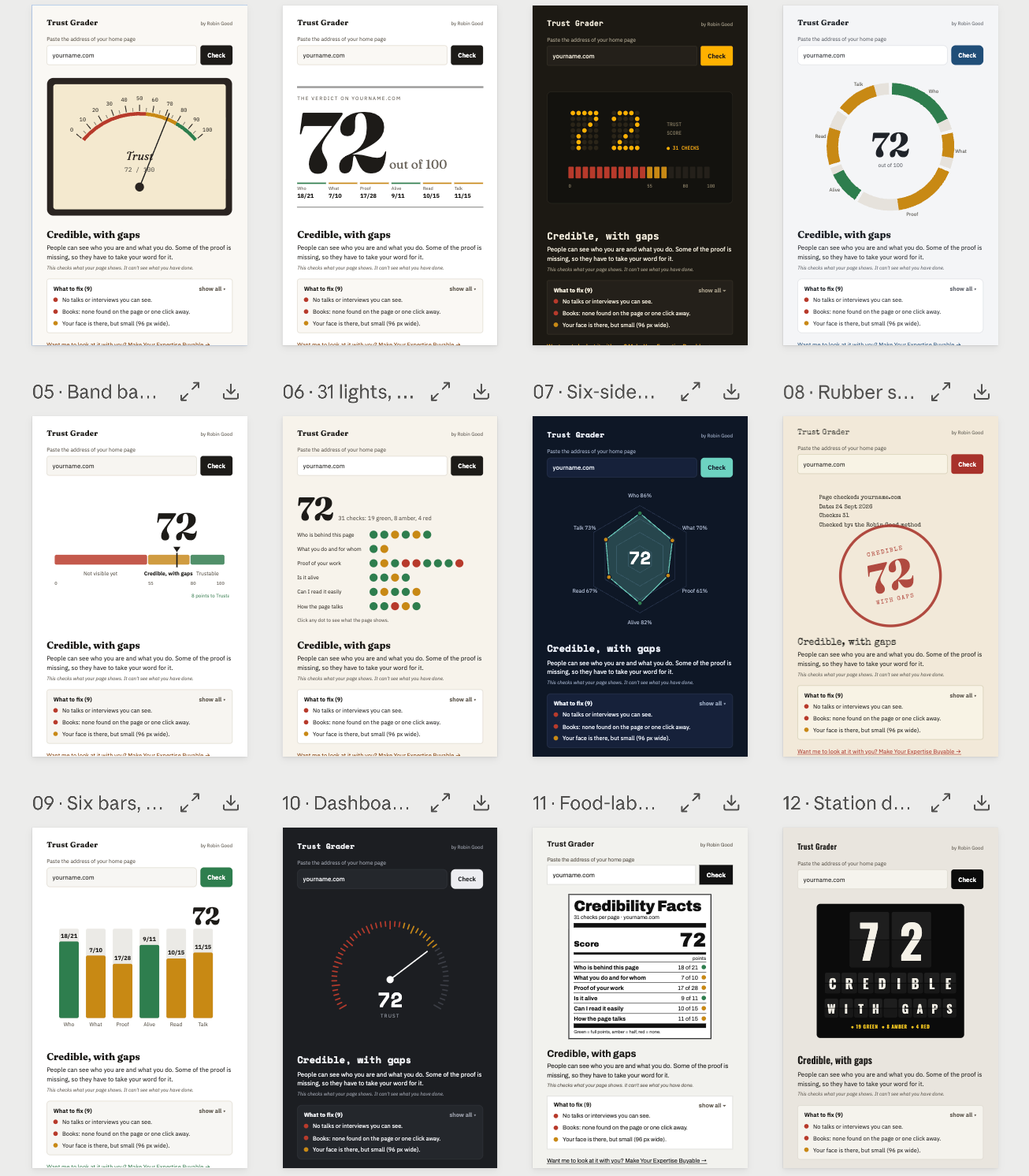
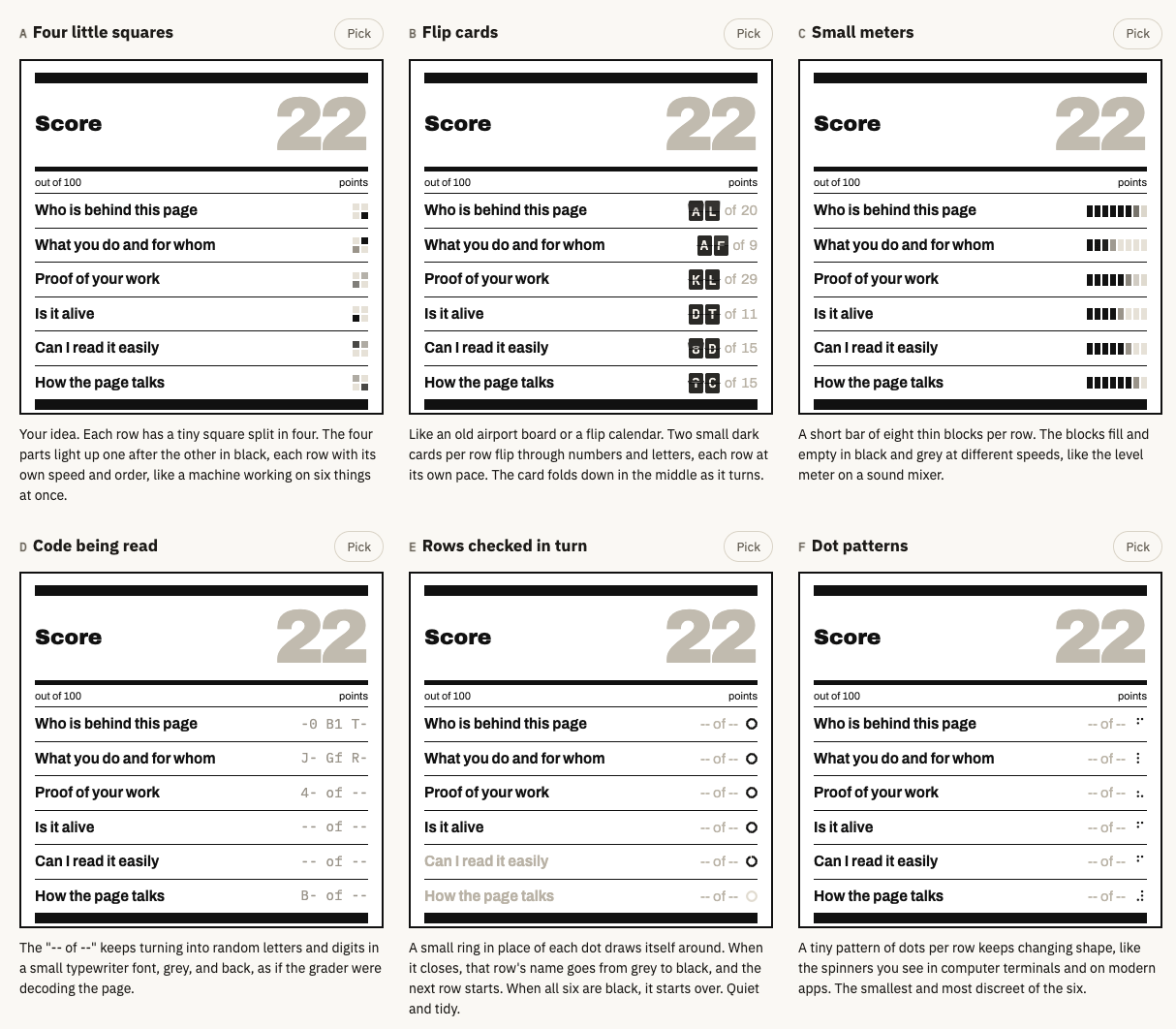
Once I had a working version of the scoring engine and had refined it on a few sample sites, I turned to the experience people would have when using the tool. I wanted the interface to be as carefully considered as the scoring logic.
I wanted the interface to be easy to scan and use, with more detail available when needed and clear information behind each check. I also wanted its design to reflect the care and transparency of the scoring system.
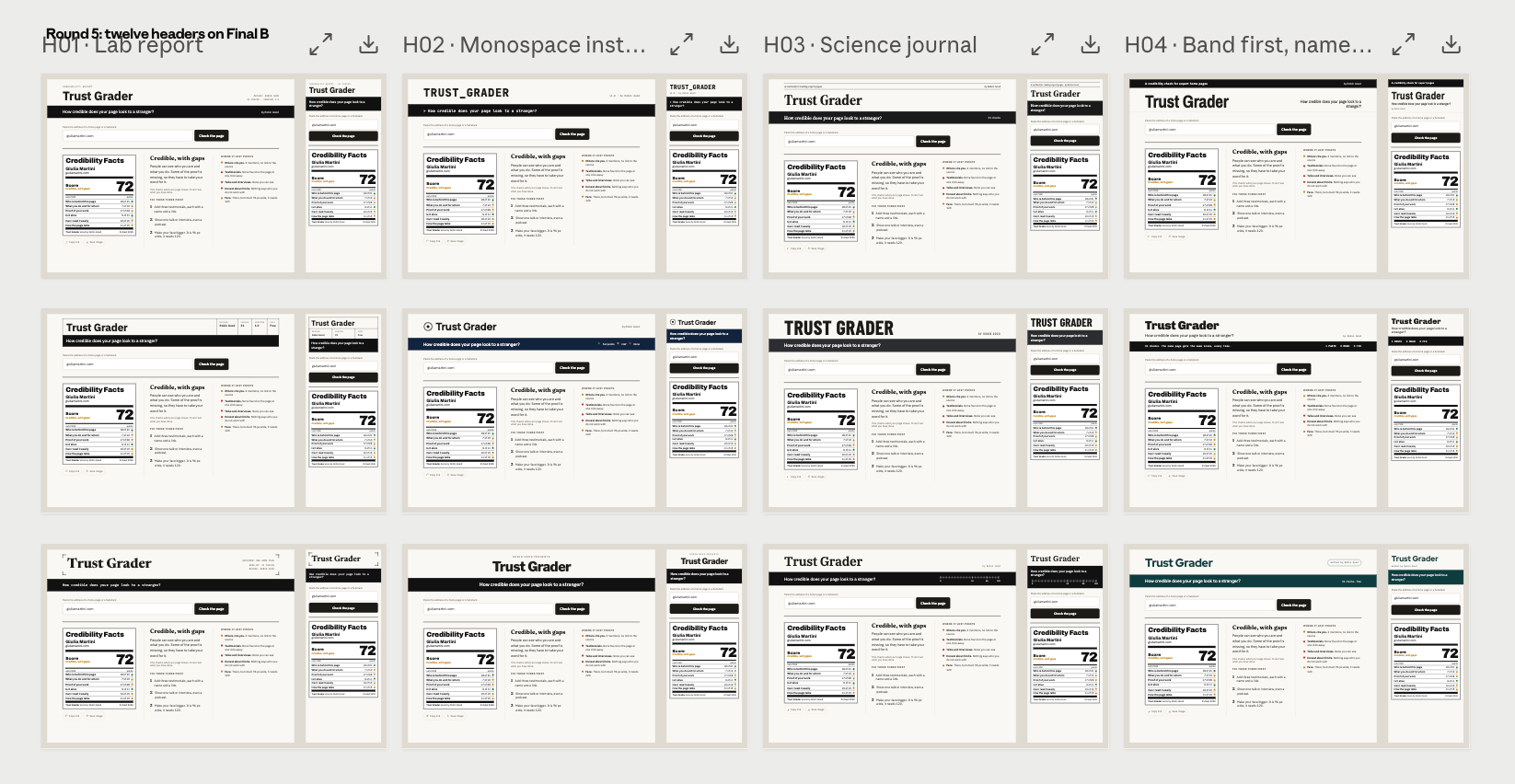
I used two approaches in combination.
a) To find the direction I use Wise Winnowing. I ask AI to generate distinct design directions within criteria and constraints I set, and then I compare and select among them.
b) To finely design and optimize within a direction I use the Bowerbird Method. I take a chosen design and generate abundant variations of one element in it at a time until I find the one that works best.
App Testing
I first compared Trust Grader’s results with my own manual assessments of 12 Italian professionals whose websites I knew well.
In most cases, the results were close to my notes. When they differed, I realized that some of my own scores reflected how much I liked or trusted the person, rather than the evidence visible on the page.
From there on I started to gradually adjust the criteria and their weights to focus the tool on observable, verifiable signals.
As I proceeded, I noticed that many of the verification steps the AI was running had some issues: how the web page being analyzed was read, how much of it was being checked, and how the app scanned and searched for specific elements on the page.
I could figure this out only by running sample tests on different pages, paying attention to what was scored and checking it against the evidence. In this way I refined for many hours how the AI engine would check, inspect, scan and evaluate / score each web page. Scores fluctuated. Changed. Until I started seeing the results become consistent with what I actually saw with my eyes.
One thing I hadn’t realized initially was that a human visitor and a search engine or AI agnet may not read a page in the same way.
At that point I chose to design Trust Grader around what a human visitor can see and verify on the site. Its score is meant to reflect a human-facing experience, rather than how a bot might interpret the page.
I’m still considering whether to add a separate mode that would let people compare the human-facing results with how an AI system or search engine reads the site. But I am undecided yet.
In its initial version the Trust Grader does its scanning, analysis and computation within less than 120 seconds for 99% of websites.
The cost for me to run it right now is of apx 13–20¢ (US) per website checked. In the near future the integration of a Jev-like “system one” AI to scan and evaluate could save a few precious cents while reducing the overall grading time. For now I must absolutely find a sponsor or this tool will rapidly run out of gas.
Making the Trust Grader Trustable
When the app began to feel usable, I wanted to check the basis for its criteria. They had grown out of my own experience and observations. I needed to find out which ones were supported by research, and where I would need to explain my own reasoning.
Would the criteria seem arbitrary? Could someone game the score? What evidence supported the way it worked? I needed to answer those questions before I could ask people to trust the grader.
And so the long research for evidence started. What academic papers, research data, reports could I find that supported each and every criterion used by Trust Grader?
I started looking through academic papers, research findings and other sources.
One useful starting point was Stanford’s Guidelines for Web Credibility, a research summary from the early 2000s. Based on three years of research involving more than 4,500 people, it identifies practical website credibility cues such as verifiable information, visible expertise, clear contact details, useful design and recently reviewed content.
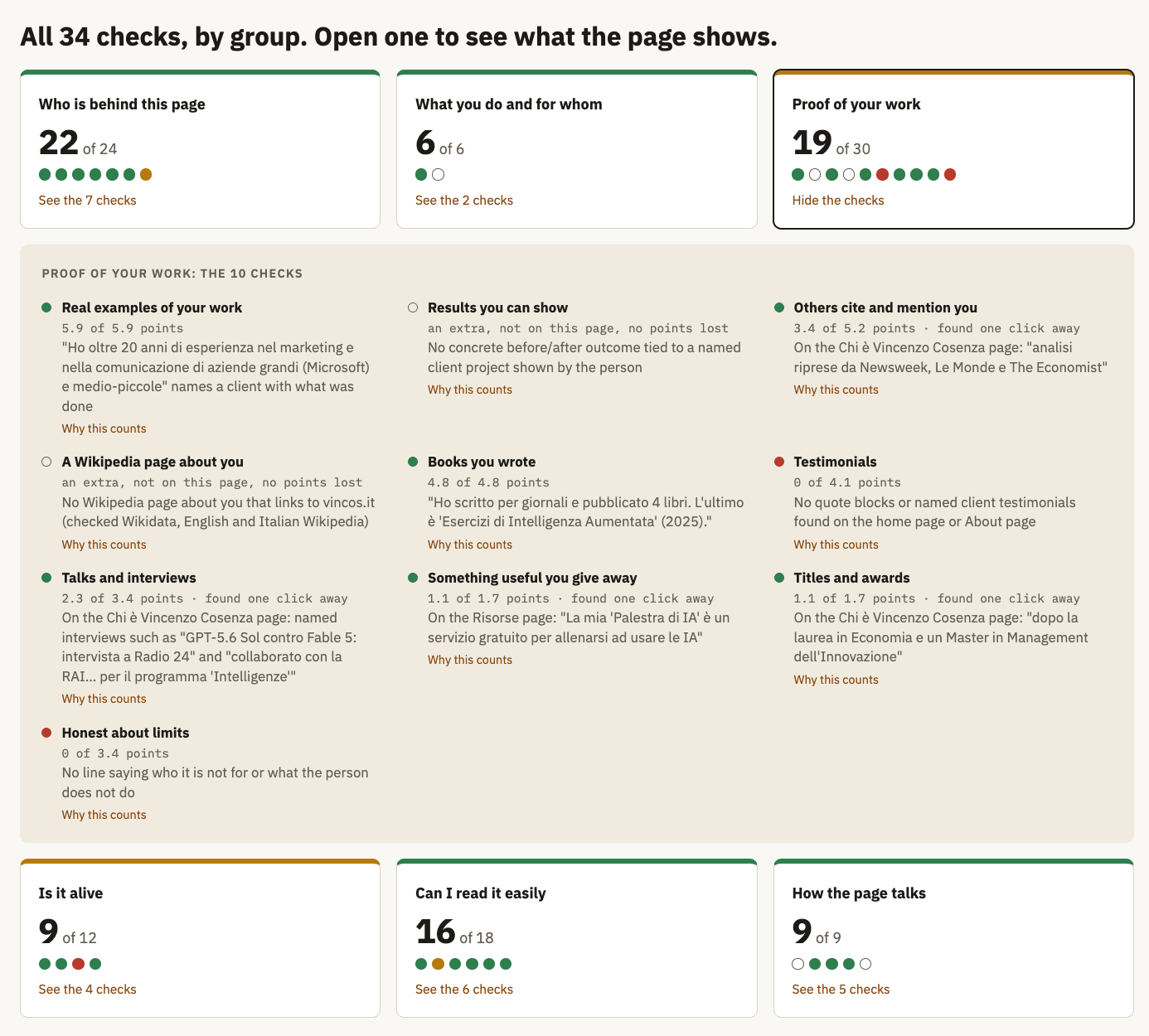
I then built a public Evidence and Research page explaining why each of Trust Grader’s 34 criteria is included, what someone might do to address it, and what research or other reasoning supports it. The rationale is there for people to examine.
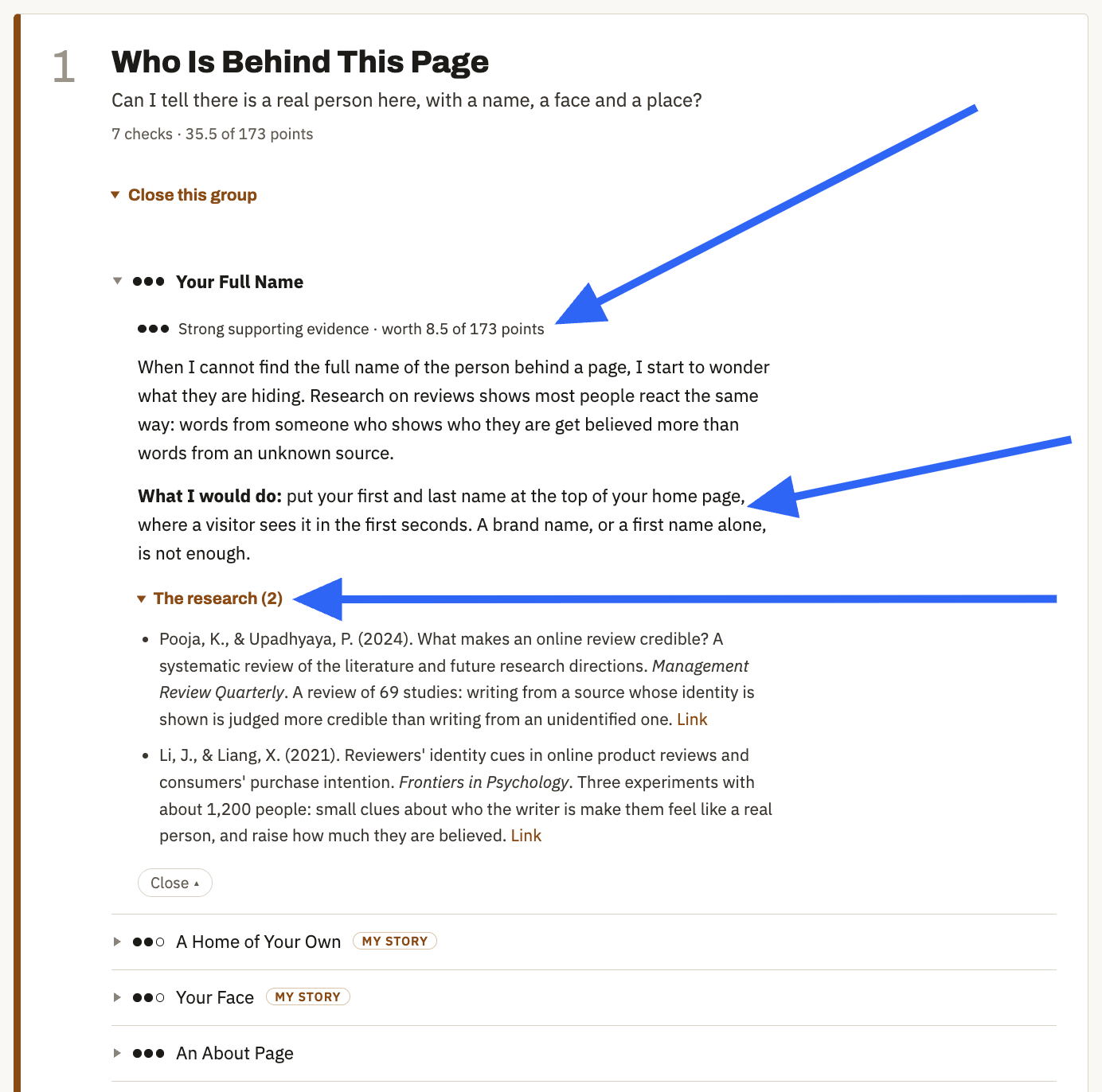
For someone using Trust Grader, this page makes the score actionable. You can see which checks your site missed, why each one matters, and what you might do to improve it. You can also review the research and other sources behind the criteria, instead of having to accept a score without seeing the reasoning.
What Good Things Came Out of Doing This
Looking back, I’m glad I took the Trust Grader route. These are some of the most valuable things that came out of it:
.
A free public tool. Trust Grader gives experts, journalists, consultants and even artists a practical way to review how their personal website comes across.
.
A way to understand and improve a score. The Trust Grader includes an Evidence and Research page where users can see which criteria their website meets or misses, why each criterion matters, what they could do to improve it, and what research or other sources support it. The score is visible, and so is the reasoning behind it.
.
A tool I use in my own work. I’ve already started using Trust Grader to improve my own website and the work I do with clients.
.
A better-calibrated set of criteria. The research I gathered led me to reconsider some of my intuition-based scoring. For example, I had underestimated how acknowledging one’s limits and boundaries can contribute to credibility and trust.
.
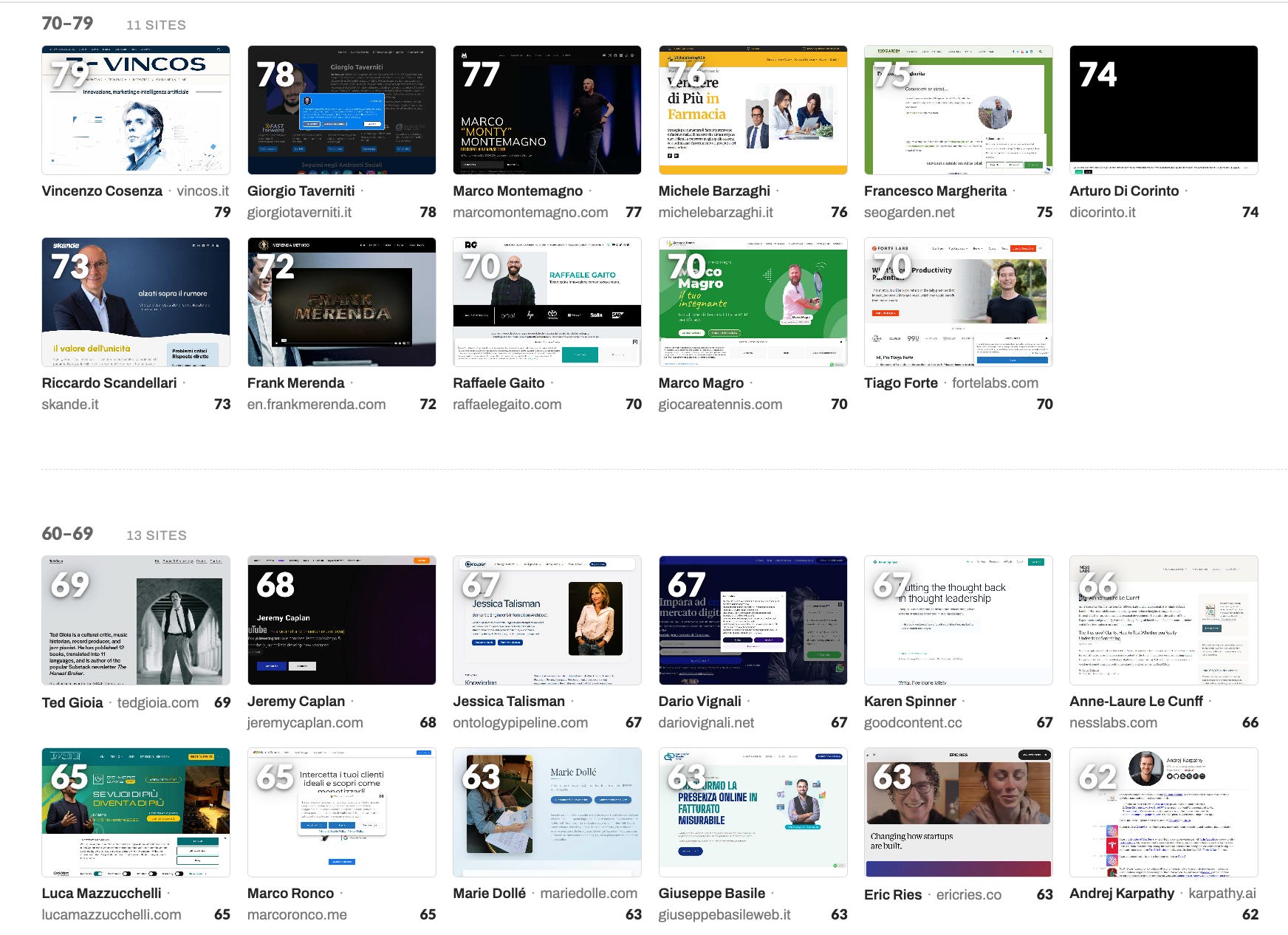
A growing gallery to learn from. The Trust Grader Gallery brings together a selection of personal websites submitted for grading, organized by score level. You can compare examples, see what different people make visible, and get ideas for your own site. It’s a reference collection of sites assessed so far, not a ranking of every independent professional online. One thing I’ve noticed is that a polished website look alone or tons of great words describing your work doesn’t cut it: It’s the verifiable information your site makes visible the thing that really matters.
.
A reminder of where judgment matters. Deciding what to build, whom it should help, which criteria to include, and how to make the tool useful took more thought and effort than the coding itself. Such experience made me experience and understand better how much the value of a tool depends on the choices behind it.
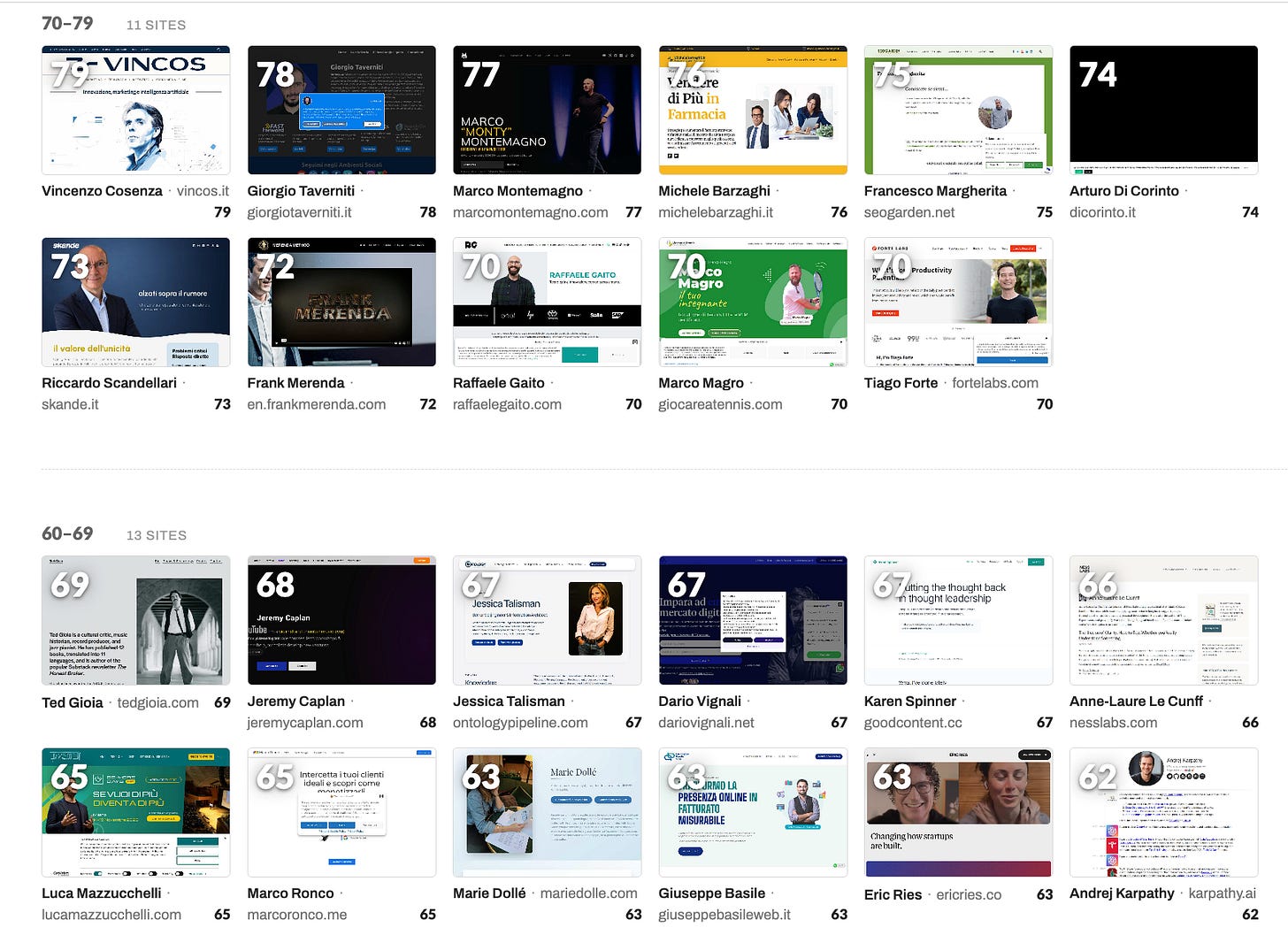
The Trust Grader gallery, where you can see an up-tp-date selection of submitted websites and their scores.
What You Can Do
If I did it, you can too, and I’m happy to help.
1. Grade your website
Use Trust Grader to review your site. The criteria and scores are visible, so you can see what might need to be clarified, updated, added or changed. The goal isn’t simply to get a higher score. It’s to make your credibility easier for a first-time visitor to see and verify.
2. Build a tool of your own
Look through your archive, second brain or knowledge base. You may have already shared useful advice, criteria and solutions to a problem across many articles. Ask AI to find that material and extract your key recommendations. Then ask it to organize those ideas and to suggest how they could become an analysis tool, evaluation, or decision aid for people facing that problem.
Ask for 12 different tool or resource ideas, not just one. If one looks promising, develop it further. If none do, ask for another distinct set of possibilities and compare them.
How It Connects To the Rest
This article-story connects to a few key concepts I have introduced before.


Nota Bene
Your feedback and critical comments are among the most valuable ways you can show appreciation for this work.
This is an ongoing exploration. I share what I think, what I choose, what I do, and who I do it with. I still make mistakes, hold wrong assumptions, and carry untested prejudices and expectations.
The recommendations I make are not dogmatic prescriptions. They are what I would suggest to my sister or brother if they asked me.
Trust Grader, its Research and Evidence page, and its Gallery will all need maintenance. That’s part of building a resource rather than publishing a one-time article.
Paradata
Why / Intent:
The main driver was following up with what I have written in #93 25 Ways To Share Your Expertise, #92 What I Think, Who I Read and #91 From Articles to Liquid Content, and in my previous articles about creating information resources (knowledge infrastructures) in place of more articles.
The goal is to get my hands dirty, try things out, explore, build, learn and think in public. Making my universe ever more transparent and useful to others. What I wished and recommended to others over a year ago, has now become reality:

Process:
The process of building Trust Grader became the heart of this article. This is the third time I’ve used my personal knowledge base to turn accumulated know-how into a resource people can use, instead of writing another article. Telling the story also lets me share what moved me, how I approached the work, and what I discovered along the way.
The essence of it, if I were to distill it is as follows:
Focus on what is of high interest and need to your audience
Query your personal knowledge base / second brain on what you have around that topic
Brainstorm and identify tools / apps / resources that can be built around that need and with the information / know-how you have already accumulated
Build the resource, test it, publish
Tell the whole story inside an article, that becomes a door to the resource and to your way of working and thinking.
Time:
for resource: “Trust Grader”
Research and brainstorming: 1 hr
App workflow and filtering criteria definition: 0.5 hrs
Functionality protoyping: 0.5 hrs
Design brainstorming and execution: 3.5 hrs
Research evidence gathering and evaluation: 2.5 hrs
Gallery of results page design: 2.5 hrs
Publishing + corrections / revisions: 1.5 hrs
Testing and revisions of app: 6.5
Tot time: 18.5 hrs
.
for this edition of TRUST-able #94
Drafting by hand (pen on paper): 2 hrs
Editing and revising: 1 hrs
Formatting: 0.5 hrs
Illustrations: 0.5 hrs
Cover design: 1 hr
Tot time: 5 hrs
.
Total apx time: 23.5 hrs
Tools:
Claude Opus 5 High - for Trust Grader design, development and deployment
ChatGPT 5.6 Luna High - for brainstorming, analysis, revisions and cover design
Claude Sonnet 5 Medium - for revisions and edits to working prototype + for scoring websites inside Trust Grader
My Curator - as primary source of information for the criteria to be used and the logic behind them

Cover image: A person evaluating another person website and taking notes. Concept by Robin Good. Image generation by ChatGPT Image 2.5.
What I Offer
I help experienced independent consultants, advisors and small expert-led firms that already deliver valuable work, but whose online presence fails to show why their expertise is different and worth paying for.
The Curation-Based Authority System (free)
55 minute video workshop illustrating how to build authority and credibility by creating high-value curated content formats, rather than original essays.
Make Your Expertise Buyable
private credibility and authority audit to help you show others how you differ and why your expertise is so valuable
Follow a path with a heart.

From Koh Samui (TH)
Robin Good
What a fantastic tool. I love the concept, the criteria, and the executable items. Very awesome tool. Thank you for making this.