


In essenceThis is a piece about what actually makes a piece of work yours, now that a machine can do part of it for you.
I learned to DJ by hand as a boy, then came back to it forty years later and found a button, Sync, that does the hard beat-matching on its own. Most professional DJs treat pressing it as cheating.
The very same accusation that is now aimed at anyone who writes with the help of AI.
My claim is that the tool you use does not decide the worth of the work, nor whether you are a real DJ or a real writer.
That is decided by the human choices behind it: what you set out to make, what you keep and what you throw away, what you check, the taste and the experience you bring, and whether you are willing to sign it and stand behind it.
So for me what counts is what I feel when I hear, or read some work. Whether be music or text. I don’t care how it was made. I care about how it makes me feel.
From November 2020 to August 2024, I lived in Holbox, a wonderful tiny sandbank island on the Gulf of Mexico where it meets the Caribbean.

There, without planning it, at age 63, an impossible dream came to life.
At thirteen (1970), I asked my parents for permission to work during the summer holidays, and I worked nights in an ice-lolly factory to earn enough money to build my first DJ console.
From London, through Europe’s capitals and then down to Rome, Italy, a new trend was spreading fast: having a private DJ at your own birthday party. And teenagers thirteen and up were all crazy about it.
That same autumn I began playing at private parties, paid, and I did not stop until my last year of high school. Hundreds of parties, lots of positive contagious energy, dozens of unforgettable memories.
At that time I played mostly 45rpm singles, danceable pop and r&b tracks that would make the floor move. Mixing was a big challenge back then. Turntables did not have instant start, fine speed control, and to match the rhythms of two tracks you had to have a great ear, know a lot of records, and the courage to take some public risks.
I invested time, bought hundreds of records, listened, practiced, and was lucky enough to play in some of the most beautiful private villas and palaces in Rome.
Then life moved on.
I went on to study, travelled abroad, and searched deep and wide for my own professional path. I loved being a DJ, but I also wanted to chase bigger dreams. One was to become an oceanographer, another a film director.


I followed those paths. I did not become either one, but one way or another they led me to other fascinating places, and then to here, where I am today.
I help experienced independent consultants, advisors and small expert-led firms that already deliver valuable work, but whose online presence fails to show why their expertise is different and worth paying for.
But back to the story.
Holbox is a long, seemingly infinite strip of sand. More than 40 km long, but less than a kilometer wide. Everything happens on the beach. The restaurants, the bars, the clubs, they are all there, in the five kilometres where everyone is (the rest is a closed-access nature reserve).

I started walking along the beach with my small portable speaker, playing compilations I had made only to please my own ears. And little by little, that music, those playlists, started opening some doors I had not even considered before.
Could I revamp my DJ skills after 40 years, and make people lose it in their bikinis in front of wonderful sunsets? Could I do it? Would I still be able to do those things?
I did not really know, but I felt I wanted to.
I had nothing to worry about, having already my “Robin Good” job online this was just a free side-play. if it worked great, if it didn’t, life would go on. Plus I had an enormous desire to share again my musical taste I had been cultivating over the years while wanting to bring as much positive energy and joy to other people, which is where natural spirit is.
I remember the first step clearly.
Passing by a beach club called La Puerta Azul with my music on, someone at the bar told me he liked what I was playing. I showed him where my playlist was on Spotify and gave him a tip so that he would play it on the club speaker. A few days later, walking past again, I heard my own playlist coming out of their speakers.
That was the green light I was waiting for.
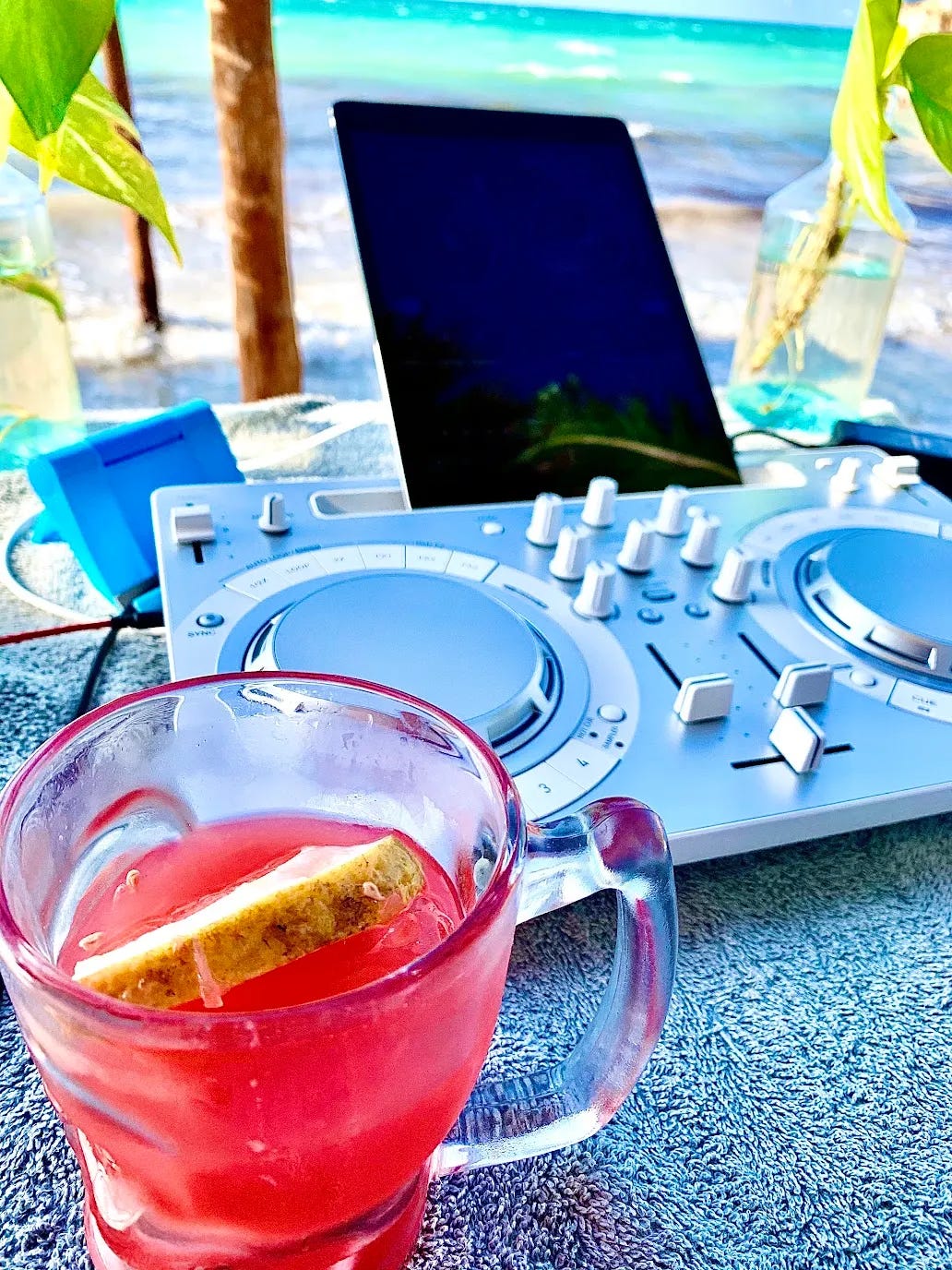
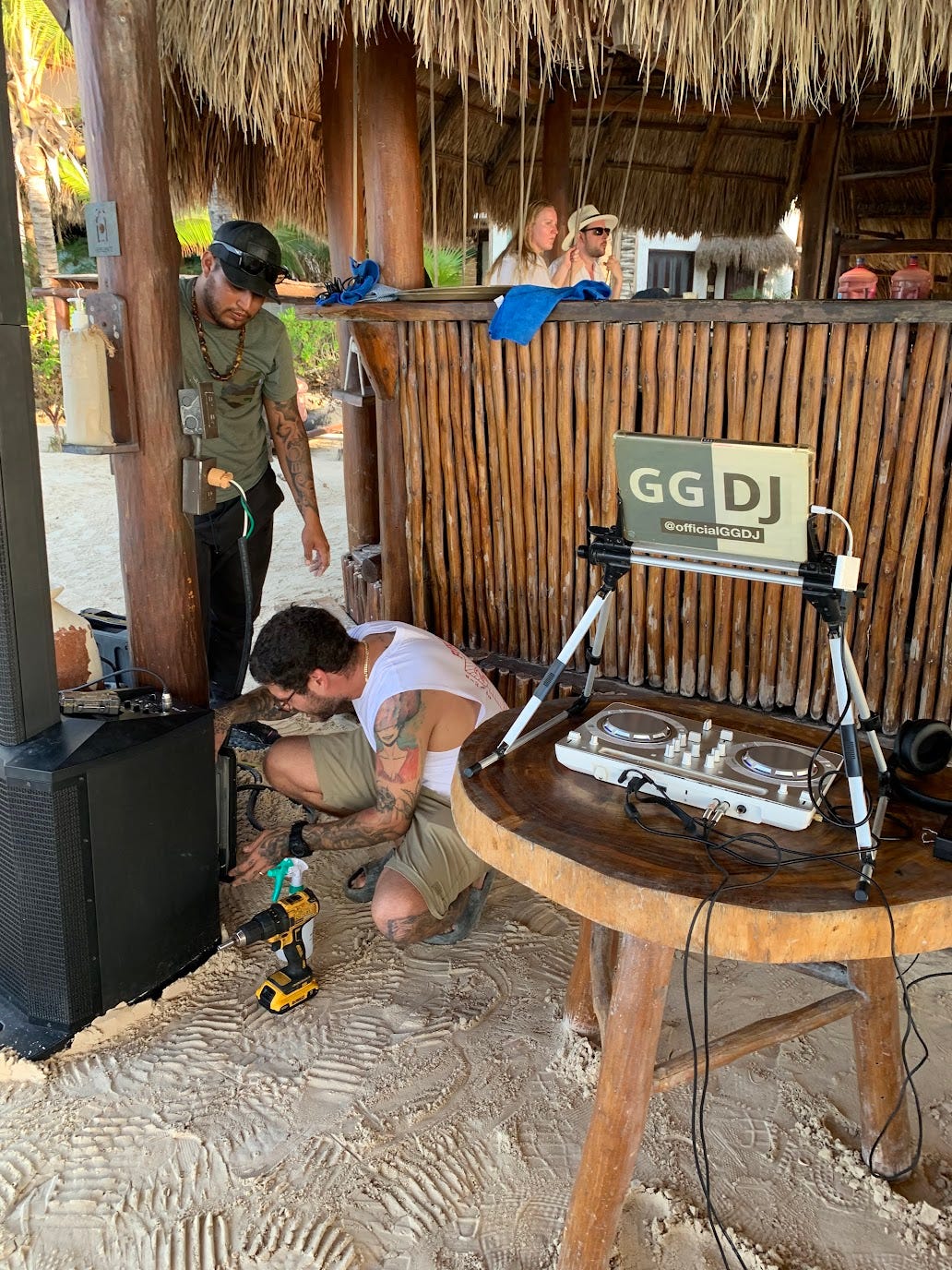
I had arrived in Holbox on November 6th 2020. By January I had already assembled a new portable DJ setup: a small battery-powered Pioneer We-Go 4 controller, an iPad, DJay as software and a powerful portable Marshall speaker. I could play anywhere, even where there was no electricity.
I chose as nickname GG-DJ and I started playing at the very place that first appreciated my music, La Puerta Azul, and then went on to Amaité, Mittoz, Barbarossa, Tribu, Nomade and a few others.
It became one of the happiest, most intense chapters of my life.


Beatmatching: From Manual to Automatic
But I had returned to DJing through a world very different from the one I had left.
When I was a teenage disc-jockey, after a few difficult years in which you really could not change the speed of a song much, the first Technics turntables arrived, with instant start and precise speed control, and they opened a universe of opportunities. But still, to mix two tracks, you had to hear the beat of the one playing, and then “by ear” change the speed of the track you wanted to mix in next, so that it matched the other one.
To achieve that, more often than not you had to slow the spinning vinyl down, using your hand as a friction brake, or speed it up by pushing it a little faster. It took a lot of ear and a lot of practice. It required effort, attention and skill. Not something anyone can do.
Now, in Holbox, the new digital controller I had just bought online came with a button I had never seen before, labelled Sync.
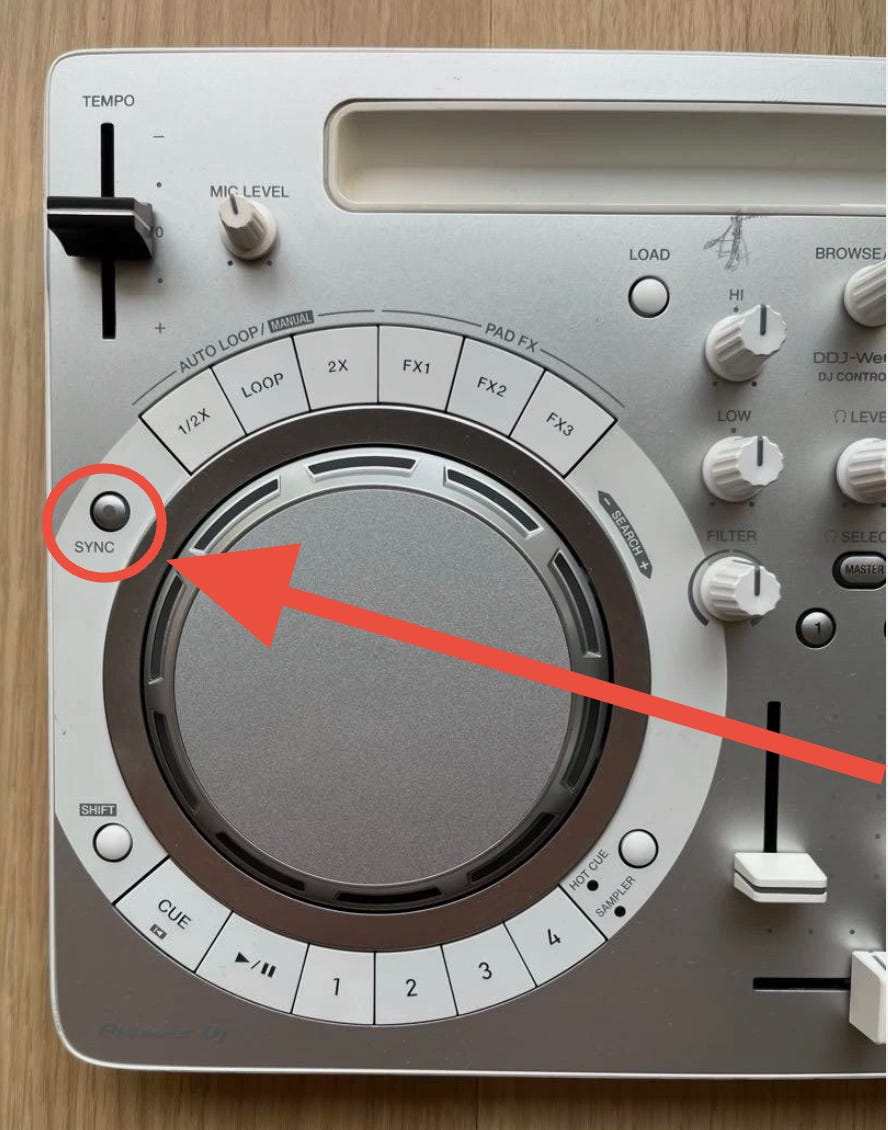
Press it, and the next track automatically matches the tempo and beat of the track currently playing.
My first reaction was: uh, that’s useful.
It freed attention. Instead of spending all my energy on a technical task, I could think more about the next track, about the emotional turn in the set, explore more options, and take more time to paint the story I was building for the dance floor.
Revolver
Then I met Oscar Castañón (a.k.a. Revolver DJ)
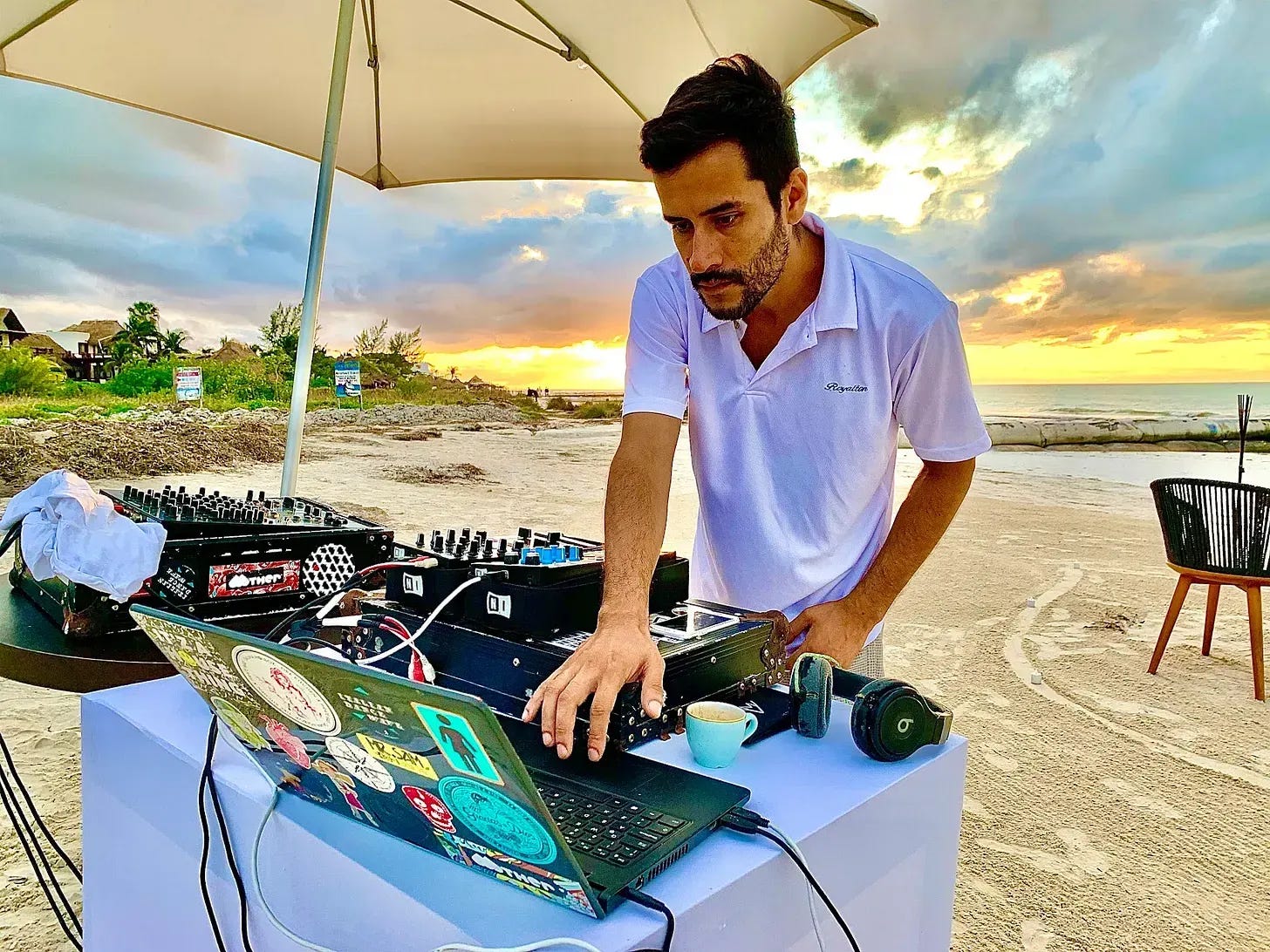
Oscar was the resident DJ at Salma, the island’s number-one club. He booked prestigious DJs for every night of the week, two of them per night: one for the warm-up session (6 to 10pm), for those dining and chilling out, and one for the late-night dance floor. He had tremendous taste in music, knew a great many artists and DJs, and he
let me in on tracks and labels I had never heard before.
He was generous, experienced, and became a good friend.
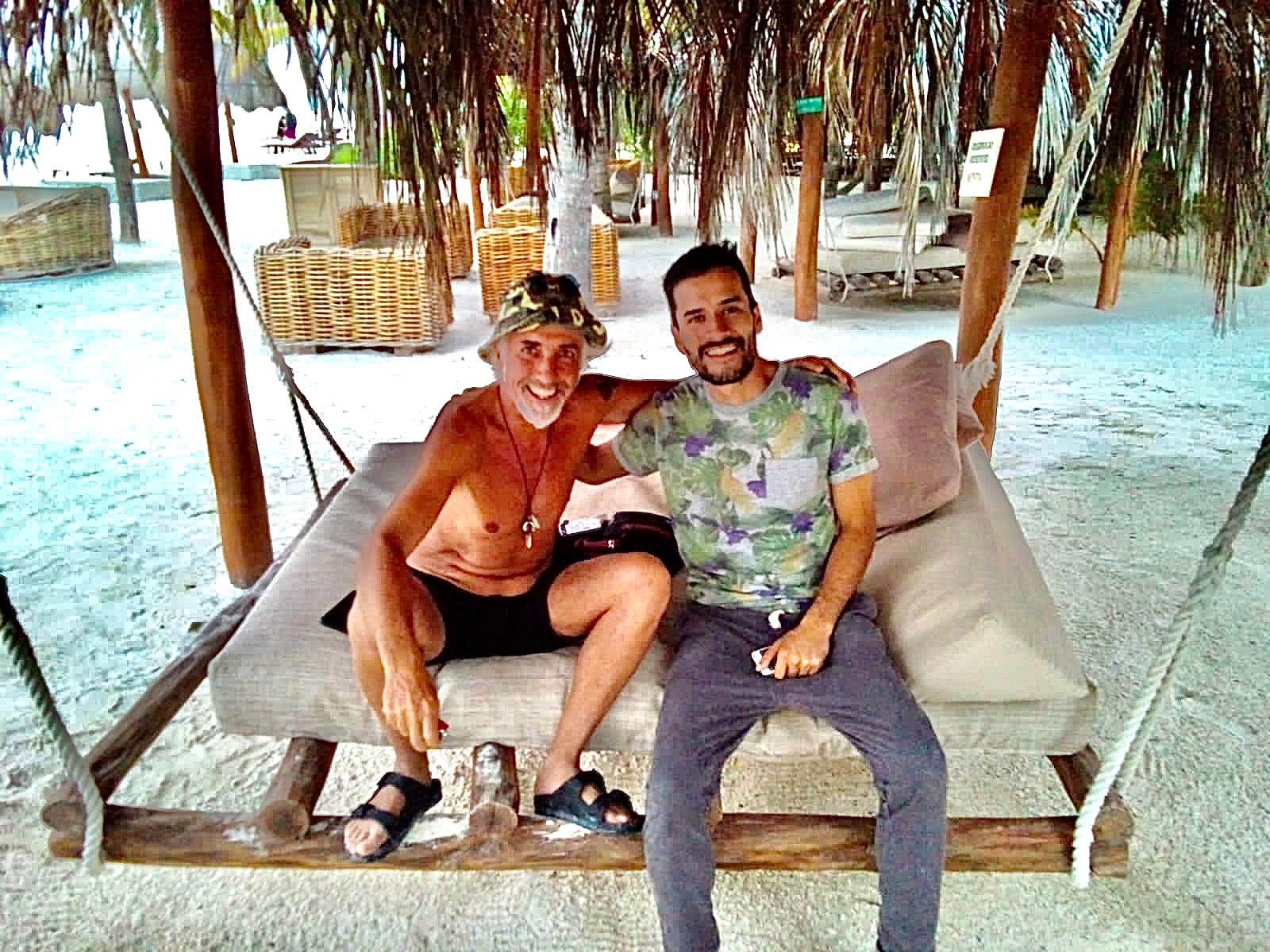
From the first moment I met him, spinning groovy deep-house tracks at the Mystique beach club, I did not hide my past as a DJ, or my growing desire to bring that skill and passion back to the trenches.
He knew my ultimate dream was to play at his club. Salma.
And so, after checking out a few of my sets at other places where I had started to play, he began inviting me to do some warm-up sets, before the hot DJ of the night.
But one night he took me outside and looked me straight in the eyes. “Listen carefully,” he told me. “Never use the Sync button when you play here at Salma.”
For him, the Sync button was close to blasphemy. A sacrilege against the heroic tradition of the real DJ.
For me, totally new to this digital world and its new technical abilities, it came as total surprise. I saw all those magical features like godsend, remembering the effort and time it took to put two tracks in sync. But I sensed he was not censoring my style or my selections. He wanted to protect the prestige of those sitting behind those decks.
I instantly understood.
And at Salma, I did not use it.
I actually enjoyed the tension of manually finding the beat again. I enjoyed proving to myself that I could still do it. It took a few hours to re-adapt my old school disc-jockey skills to the new tech, but once I got the feel of how to ride the new horses, I could manually beatmatch any two tracks, just as I did when I was a young disc-jockey.
It’s the Result That Counts, Not the Tool
Frankly, I do understand Oscar’s position.
For DJs who learned the hard way, manual beatmatching is not a trivial gesture. It represents training, ears, instinct, discipline and a certain respect for the craft. A machine that makes it easy at the press of a button can feel like it is taking away something important: the visible proof that you earned your place behind the decks.
The same is true for writers who feel that AI-assisted work should not be called writing.
I can see their reasons. They are worried about deception, laziness, the loss of skill, and people claiming credit for work they did not truly understand or make. These are not stupid concerns. They deserve respect.
In fact, I have no real interest in convincing anyone to use Sync or AI. Everyone is free to draw their own line and work according to it.
But I do think it is inappropriate to judge a DJ simply because they use Sync, or a writer simply because they use AI.
People Can’t Tell Whether You Used a Tool or Not
And so, outside that small priesthood, I kept wondering: why should a useful tool make me less of a DJ?
A packed dance floor cannot tell whether I used Sync.
In the same way, even experienced readers cannot reliably tell good AI-assisted text from good human writing.
When two researchers tested this with poetry, more than 1,600 readers picked the AI-written poems out from the human ones correctly only 46.6% of the time, worse than a coin toss, and they rated those AI poems higher on rhythm, beauty and emotion than poems by Shakespeare, Dickinson and Plath.
And this is not only true for ordinary readers. When the medical journal Stroke ran a blind contest and asked expert peer reviewers to tell human-written essays from AI-written ones, the reviewers guessed right only about half the time, no better than a coin flip, and they too rated the AI essays higher when they did not know who had written them.
People can tell AI slop a mile away, yes. But they cannot tell really good AI-assisted text from the rest, not when the human author behind it has spent enough time to leave his own fingerprint on it.
People do notice bad mixing. When two tracks stomp on each other awkwardly. When a set goes nowhere, slow, boring, with no soul. When the energy drops, when the DJ loses the room, when the dance floor suddenly empties because the last mix was never meant to be.
But when the mix works, they respond to the performance: the selections, the juxtapositions, the timing, the gradual rise and fall of energy, the unexpected turn, the musical plot.
Nobody dances because you manually adjusted a pitch control.
They dance because you gave them something worth dancing to.
From the DJ booth. One typical night at Salma. The n.1 restaurant / night club at the time (2020-2023)
Roque “roquero” dancing on top of the ruins of an old bar, the ocean waves had eaten out. In front of the Puerta Azul (2023).
True Authorship
This is why the argument about AI-assisted writing often feels strangely familiar.
One side treats the use of AI as proof that the resulting work is somehow impure. Not really written. Not really yours.
The other side says that tools are tools. What matters is the human being behind the output, the one who decides what to make, what to keep, what to reject, what to verify and what to publish.
I definitely feel closer to this second position.
Using AI does not automatically make someone a writer. But neither does typing every sentence manually.
A person can write every word alone and still produce recycled, careless, misleading, shallow work.
Another person can use AI to research, test angles, expose gaps, generate alternatives, reorganize a difficult draft or improve clarity, and still keep total authorship of his work.
Here’s the foundation of this way of thinking:

The difference is not hidden inside the tool you use. It is visible in the decisions. In the choices you make.
Who chose the subject? Who framed the question? Who brought the experience, point of view and criteria? Who checked the sources and removed the false claims? Who decided that one paragraph felt true and another sounded clever but empty?
Who connected the piece to a body of work, real readers and real consequences? Who is willing to put their name under it?
That is where authorship lives.
The Sync button did not choose the music for me. It did not read the beach. It did not notice that the dance floor was tired, that a slower track was needed, that two apparently incompatible songs could create a small miracle together.
It only handled one mechanical task.
AI can handle more than that, of course. It can produce whole paragraphs, and that makes the responsibility of the author even greater. You cannot press a button, publish the result and call it judgment.
But refusing a useful tool simply because it makes one part of the work easier is not necessarily a good way to protect that art. It is perhaps, more than anything, a natural-born defence system that kicks in when technology makes it too easy for others to present a polished output even when there is no true taste, history, depth or understanding behind it.
There is value in learning the craft underneath the automation. I am glad I learned to beatmatch manually early in my life. It gave me ears, confidence and respect for the work.
A good writer should know how to think, research, structure an argument and write without having to depend on a machine.
But knowing how to do something manually does not mean you have to do it manually every time.
The Real Test
The real test is not: did you use Sync?
The real test is: did you make the dance floor come alive?
Likewise:
The real question cannot be: did you write it with AI?
The real question must be: what did you feel when you read it? Did it inspire, teach, inform, surprise you? Did it leave you with something useful? Did you enjoy reading it?
That’s what matters.
By now you know where I stand. What makes the work yours is what you choose, keep, check and put your name to, whatever tool helped you get there.
There is one thing you cannot judge for yourself though: how all of that reads to someone meeting your work for the first time. You look at your homepage and your last few pieces already knowing what you meant, so you cannot feel where your expertise looks real and earned, and where it looks polished and empty. That first read is the one thing you cannot do for yourself, and it is what I do.
I go through your online presence the way a new prospect does, cold. I record what I see and think as I move through it, and I send you the video. Then we sit together online and go through what is working, what is quietly costing you trust, and what I would fix first if it were mine.
If you want that outside eye on your own presence, this is where I do it:
Make Your Expertise Buyable
N.B.: This is only my perspective about AI, and about a button that some DJs consider the devil.
My feel: Yes, I like to use tools that give me extra creative space and which can automate something I already know how to do. But I don’t like to depend on them.
I still get still a thrill by manual beatmatching, and I am enjoying as much the words I am writing now on this paragraph.
Keep your own rules. Don’t listen to me.
La Puerta Azul, the first and the last place where I played during my 3 years as a DJ on Holbox island.
Sources
The claim that good, human-directed AI-assisted writing cannot be reliably told apart from good human writing is supported by two independent studies:
Brian Porter and Edouard Machery (2024). AI-Generated Poetry Is Indistinguishable from Human-Written Poetry and Is Rated More Favorably. Scientific Reports. Across more than 1,600 everyday readers, people identified AI-written poems correctly only 46.6% of the time, below chance, and rated them more highly than poems by celebrated human poets.
Lee H. Schwamm and colleagues (2024). Reviewer Experience Detecting and Judging Human Versus Artificial Intelligence Content: The Stroke Journal Essay Contest. Stroke (American Heart Association). Expert peer reviewers distinguished human-written from AI-written scientific essays only about half the time, no better than chance, and rated the AI essays higher in quality when authorship was hidden.
Paradata
Why / Intent: In the spirit of connecting things that superficially seem worlds apart and with little in common I chose to draw a parallel for one of the hot topics of the time - writing with AI - and by lived experience as a 60+ DJ.
Process: I brainstormed for quite a few hours the direction of this article. I had the topic, I had a story, and I had seen that there was a visible connection between the present debate around authorship and AI, and my personal, lived experience as a DJ, on the island of Holbox.
So, I told my story as DJ to ChatGPT and told it the connection I saw with AI writing. I then asked it to bring the whole thing together. I heavily added to it, by providing names, feelings, more facts than the draft general idea contained. Edited a lot. Wrote and added a lot.
I then asked AI to do some research to support my claim and verified that it was relevant.
I finally researched my archive photo library and started the final formatting.
Last thing, before writing this Paradata section, was to re-query the AI on my title choice against my readers’ data. The title had already naturally emerged during the initial brainstorming and at this stage Claude could not find a better alternative.
Times:
Brainstorming with AI: 3.5 hrs
Drafting: 2 hrs
Re-writing and Editing: 2 hrs
Research: 0.25 hrs
Images research: 1 hr
Cover design: 0.5 hrs
Revisions and corrections: 0.5 hrs
Titling: 0.5 hrs
Total apx time: 10.25 hrs
Tools:
ChatGPT for brainstorming ideas and direction. Cover design. Revisions and corrections.
Claude Opus 4.8 for brainstorming, titling.
Follow a path with a heart.

From Koh Samui (TH)
Robin Good
This is so spot on! This is the level at which we should be having this discussion: what is being made and what it makes people feel.
I have close friends who are music producers, so I am VERY much aware of the Sync button debate. And I have always found it ridiculous! Now the same thing is happening with AI. Apparently, using it means you are no longer a “real” producer.
Every new and sufficiently disruptive technology seems to create its own Sync button debate. Engineers defend manual coding. Musicians defend the tools they learned to use.
But does someone on the dance floor care whether the music comes from vinyl or a USB stick with a Sync button? Does someone using an app care who typed every line of code?
The producers I know want to put their energy into the music and the sensations it creates. That seems like the quality worth paying attention to. What does the work do to someone?
Sometimes I wonder whether people are defending the years they spent learning skills that very few others were willing to invest in. Those years gave them an advantage and made them part of a small group. New tools give many more people access to those skills. Suddenly, they don’t feel as special…
Maybe that’s what makes the Sync button so threatening.
Great life story, Robin. Thank you for sharing it!
Cool article. And full disclosure, down to the minute. Indeed the back story keeps you swiping, and glad to know that part was not inferred by AI. It was a narrative that kept me scrolling away, and getting to know you. Great analysis Robin!