


You can write clearly. You publish consistently. You do get some attention.
But still, people don’t see you as a trusted source.
They read, but they don’t bookmark. Few leave a like, fewer subscribe. None comment authentically. Zero report of having acted on what you advise.
There’s a gap most experts don’t see between having real expertise and being perceived as a trusted source. Writing more content doesn’t close it. In many cases, it makes it worse.
That gap is not about visibility.
It’s not about clarity.
It’s not about consistency.It’s about something else entirely.
You have spent years, maybe decades, building real knowledge in a specific field. You read about it, think about it, follow its developments, not because someone asked you to but because you are genuinely interested in it.
And yet, somehow, it is not translating into the online visibility and trust you expected it would. You publish, you share, you explain. People read you occasionally. But you are not yet the source they bookmark, come back and subscribe to, or recommend to others when someone needs guidance in your field. Something is not connecting.
That “something else” is not hard to spot once you know where to look. It’s not one big problem. It’s five very specific ones that show up every time an experienced expert tries to build trust online.
And they all point to the same missing layer. Once you see how they connect, the real issue becomes obvious.
1) Content
What do I actually write about? And even when you find an answer to that, how do you create real value consistently, week after week, without running dry or repeating yourself or producing things that feel thin?
2) Differentiation.
Your field is not empty. There are already people writing about it, podcasting, making videos, courses, tutorials and building audiences and small communities around it. What makes you different from them, and how would anyone know?
3) Credentials / Credibility
This one is particularly hard for people starting online later in their life career: how do you build credentials quickly for something you are only now beginning to do publicly, in a digital format, even if you have been doing it under different contexts and circumstances for years?
4) Visibility
You publish. Almost nobody reads it. You have no platform, no following, no algorithm working in your favour, and growing from zero feels impossibly slow.
5) Trust
The one that underlies all the others: how do you become trusted? Not just known, but genuinely trusted, seen as credible, authoritative, worth following, by people who have never met you and have no particular reason to take your word for anything yet?
These are not small problems.
They are the five specific reasons why most serious, capable people who try to build an online presence in their field end up giving up, or publishing into the void for years without anything changing. And they are the five reasons why the standard advice of “write consistently, share your insights, be authentic, post more”, tends to fail. It fails simply because it does not actually address any of these five specific problems. It just tells you to keep doing the thing that actually isn’t working anymore.
In my experience as an independent, sustainable online author since 2003, I have gradually relied on one approach that addresses all those five problems simultaneously.
It is not a content hack or a growth tactic. It is a fundamental rethinking of what the best role for an expert in any field should be when it comes to establish an online credible presence. You cannot do that anymore by opening another blog. That time is gone.
What you can do today - which having a blog didn’t make necessary - requires true competence, boldness and a human voice with a perspective. Almost nobody does it.
That approach is curation. Not link-sharing. Not aggregating headlines. Serious, opinionated, consistently focused curation of what matters in a specific niche, for a specific audience, around a specific need. Becoming the person who has looked at everything and can tell you what is actually worth your attention, and why.
A reasonable rule‑of‑thumb estimate is that somewhere between 10% and 20% of indie blogs, newsletters, and Substack and Medium‑style publications worldwide are primarily curated recommendations, sense-makers or explainers of what to read, with the rest being mixed (some curation + some original) or almost entirely original. (Source: Perplexity)
That’s the essence of it.
Consider for a moment the people your audience already trusts and follows. The names they recognize. The voices they return to without being asked.
Ruben Hassid, Tom Orbach, Anu, Joshua Parkinson, Mapu, Jeremy Caplan, Michael Simmons, Thomas Klaffke.
If you don’t know any of these emergent highly trusted guides, look at the long-established ones: Robert Scoble. Maria Popova. Daniel Pink. Ted Gioia. Kevin Kelly. Ben Thompson. Michel Bauwens. Jakob Nielsen.

Look closely at what these people actually do. Every single one of them is, in practice, a curator.
They organize, select, synthesize and reframe what others create. They are not primarily generators of new ideas. They are trusted filters of existing ones. Their authority did not come from writing more original content than their competitors. It came from the consistency and quality of their judgment, applied publicly over time to a specific domain. You cannot unsee this once you see it.
Now let’s go back to those five walls.
Curation takes them all down, structurally and permanently.
The content problem disappears because you are no longer trying to invent, you are selecting, organizing and contextualizing what already exists, which is an inexhaustible resource if your curiosity is genuine. You don’t need ideas or titles. You identify topics / themes and relevant curated formats and you keep filling them.
The differentiation problem dissolves because almost nobody in your field is doing this seriously, which means the moment you begin you are already in a category of one.
The credentials problem, which is the hardest one for people starting late, is solved faster by curation than by any other approach, because a well-curated collection of what matters in a niche immediately demonstrates that you know the field from the inside. You cannot fake it. Poor selection reveals inexperience instantly.
The visibility problem improves because curated resources such as directories, collections, organized selections with context and commentary, are the things people actually share, bookmark and return to, unlike articles which are read once and forgotten. In addition, curated content actually forces you to link, interconnect, show parallels and invisible relations, making you instantly visibile to tens of sources and authors you mention and highlight.
And building trust, the hardest problem to overcome, becomes a non-issue simply because the curation approach is an editorial format that by definition shows, illustrates and explains rather than claiming, pretending or persuading. Instead of having to demonstrate, perform to impress or convince people that you are an expert, you keep on showing them the map of what you know - the landmarks, the connections, the contradictions, the things that matter and the things that don’t. That map is your proof. Proof that you can be trusted.
Now let me make a final consideration. This may seem obvious. But it is not.
What I observe is this:
1) There are more and more authors online everyday. Writing across all possible topics. Thousands of articles every day. With and without AI.
2) People try to keep up, but the growing sensation is that it is kind of impossible to follow it all and you have to give up the idea of really being in-the-know and staying fully updated. There’s too much of it to do it.
3) The natural consequence of 1) and 2) is that most people, in whichever field, sector or niche need the most is having access to credible online sources that instead of giving them more content and ideas help them understand, make-sense, and pay attention to what is really relevant: sense-makers, analysts, explainers, scouts, rangers, curators.
4) Only very few people take on this role. Most everyone else is trying to show off having more and better ideas. And the few who would have the experience, competence and taste to do it, have not yet realized how significant would be their impact if they did so. Just look around.
The demand to transform themselves from sources to trusted guides is there. There are just very few experts realizing this and picking it up.
N.B.: There is though, one peculiar condition that makes all of this work. Curation without a point of view is just link-sharing, and link-sharing is worthless.
What separates a trusted guide from another writer online is the specific lens they bring to what they select. The criteria only they have developed. The perspective shaped by their particular years of experience and genuine interest. The consistent angle through which everything they curate is filtered and explained. That viewpoint is the one thing no competitor can copy and no AI can generate. It is their most valuable and most undisclosed asset.
Making that lens visible, consistently, is where the real value is.
Your Reasonable Doubts
Note: I have been writing about curation and trust-building for independent experts for more than twenty years. I genuinely believe in everything I have written above.
Yet you may reasonably ask: Robin, but how is it then, that if all this is true and you have been saying it for such a long time, you do not have tens of thousands of readers and hundreds of paying subscribers?
Here my answers:
a) I have made two major mistakes:
I have not been consistent. I published constantly for 14 years, and then satisfied by good results I got lazy and inconsistent. I thought that what I had acquired in reputation and authority would last forever. It didn’t. I lost somewhat belief that I was myself correct. I didn’t keep the digging and the exploration active, thinking that what I thought I was revealing had become obvious to all.
b) I have never been a great seller, promoter or marketer or my stuff. I enjoy the process, the learning, the exploration but I resist, pushing, promoting, convincing others to get my products and services. To be honest, I have come to dance, not to sell the hot dogs.
c) On the other hand, having chosen this work has allowed me to live an independent life, without luxury and extras, but with lots of flexibility, free time and in some of the most beautiful places around the world. So, this may not shine through my articles, but it is - at least for me - worth the price of the entire ticket. I wouldn’t exchange it for more paid subscribers and thousands more views. Having space and time to work on what you love from the place and environment you feel good in, is priceless.
d) Yes, I do not have a large following and hundreds of paying subscribers, but I do have authority and credibility in this field that few have been able to build. If you ask any of the major AIs ”who are 5 actively writing independent experts on digital curation online outside the art and academic world, writing for experts, consultants and knowledge entrepreneurs?”, it is likely I’ll be in their answer.
Here is some proof:
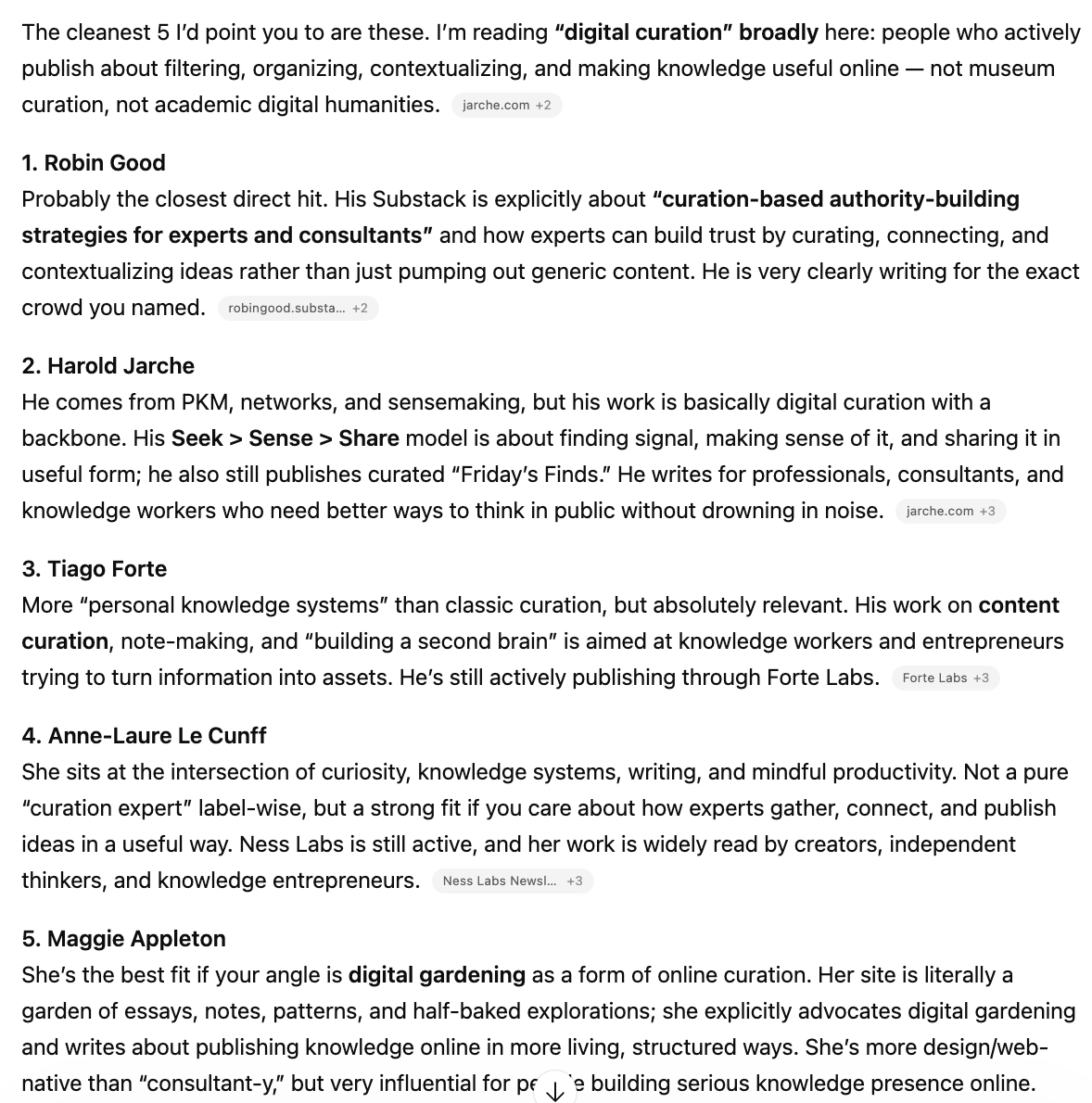
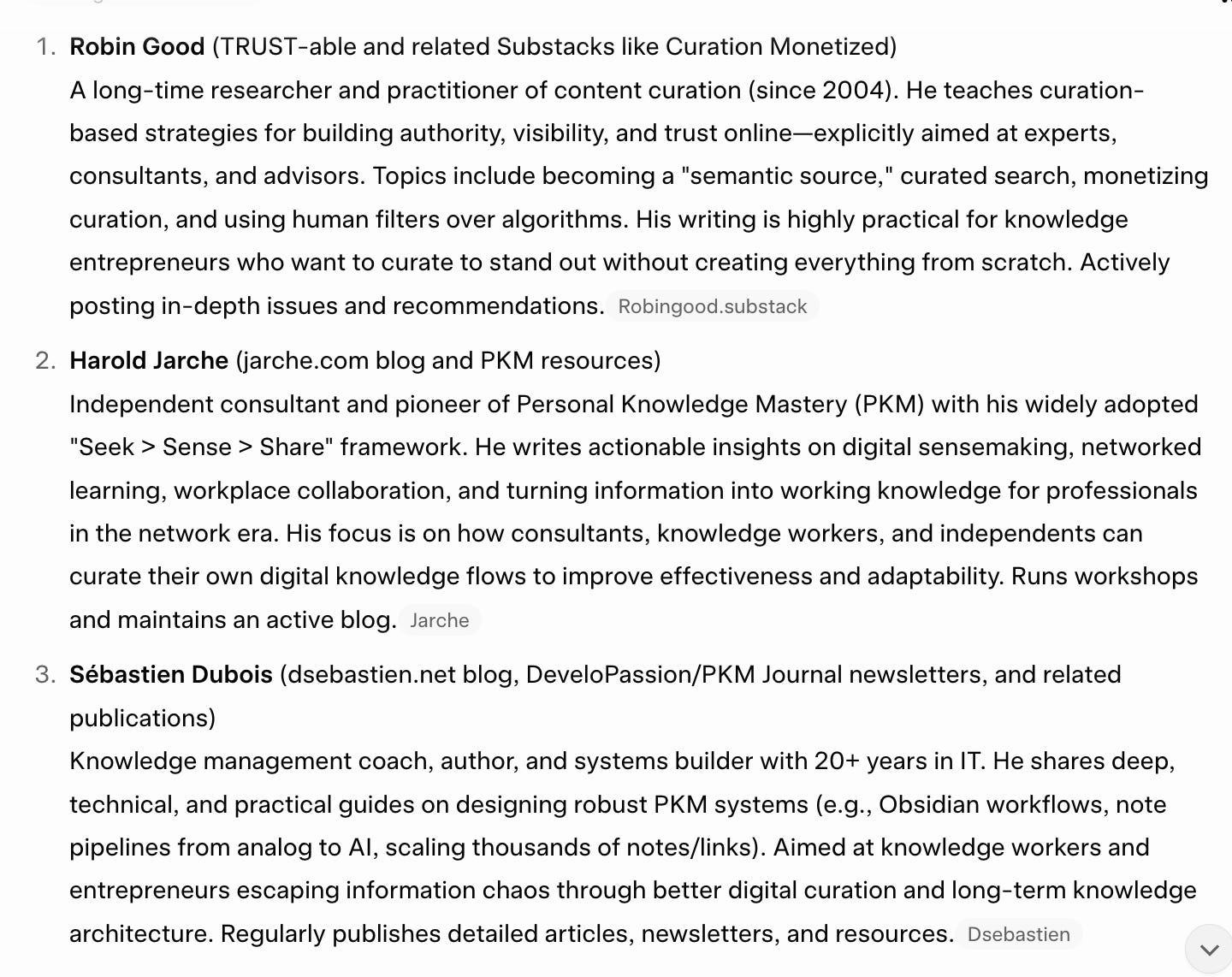
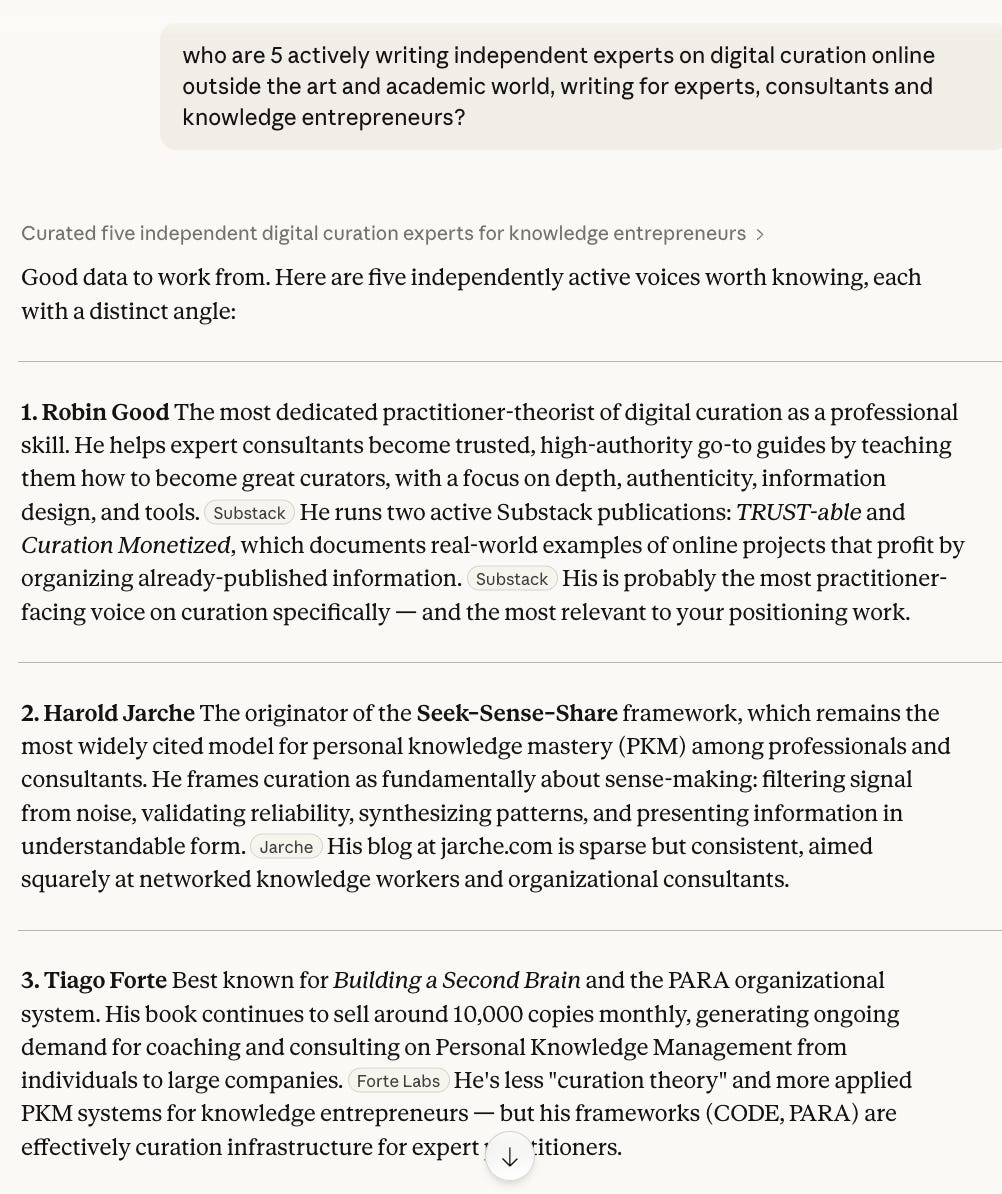
So yes, I may not be famous, rich, or have tens of thousand of readers, but I do have what most other authors are after: being recognized and trusted for what I am good at while being able to live a stress-free lifestyle in a highly suitable location.
In synthesis: The path I am describing works. Not because I say it, but because the logic behind is solid, time-tested, and well proven by tens of real examples out there. If you think it is not, kindly challenge me in the comments.
Curation requires patience, genuine curiosity, and the willingness to keep showing up with your honest evaluation and filtering skills even when the numbers are not yet what you hoped for.
If you are looking for a fast track to a large paid audience, this is not the right direction to take.
But if you are interested in becoming a highly trusted voice in a specific field and want to build things that are useful, appreciated and that last, then I think you should check, verify and try to challenge what I have told you so far and see where it fails. Because - if after inspection - it doesn’t crumble, it really shows that this is indeed a powerful, highly underestimated and misunderstood path, many experts and advisors should seriously consider now.
In this direction, there are plenty of open prairies right now, as curation is still rare and often misunderstood, but like any new frontier place rich in opportunities, it will not stay like this forever.
Curation-based authority is not a shortcut. It is a long game. The trust that makes people eventually pay for your guidance, hire you as an advisor, recommend you to their colleagues — that trust builds slowly, compounding over time like interest in a bank account that takes years before the numbers start to look interesting.
Curation not only is a logical, strategic editorial move, but it also makes for a great path with a heart. Born in the service of others.
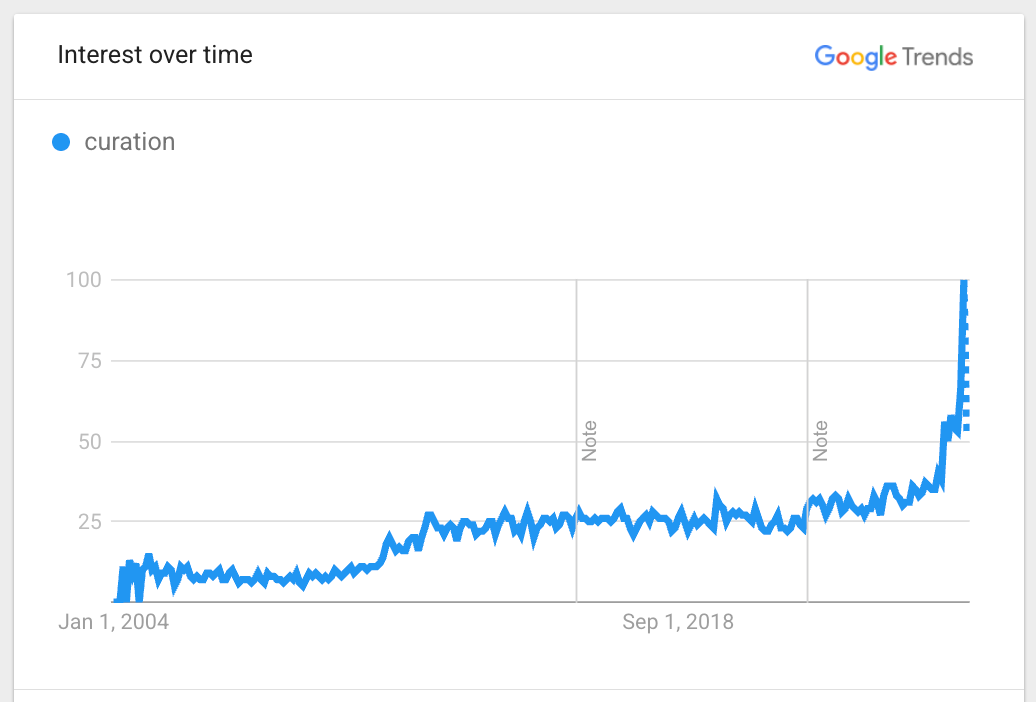
Takeaway
In your next month editorial calendar, start introducing some curated content formats, besides your traditional essays and opinion pieces. Test them, try them out and see how it feels to move from being just another voice to be a recommender of what is relevant and how it all fits together.
You can reserve one hour of your time, to watch a simple video workshop that takes you through the most basic curation formats to build authority and credibility online, while showing you the requisites, the examples, the key steps to follow and the easy-to-make mistakes you need to avoid.
For readers of this issue, the workshop is 100% free. Just click the link below and even if the suggested price says $15+, put zero in the price field and access it now as a welcome guest.
Alternatively, if you do not have time, check this specific article with the same focus:

How to Continue the Exploration
If what I have outlined makes sense to you and you are curious enough to want to dig deeper, this is what I suggest you check next:


Cover image: Photo by Robin Good - on an Italian train, writing and brainstorming with Gino Repetto. Nov. 2018.
Follow a path with a heart.
The time is now.

From Koh Samui (TH)
Robin Good
.