


An expert who follows a field closely can do something useful for the people working in it: find the material worth their attention, and explain why.
Since the early 2000s, I have published and curated newsradars around the key subjects I cared about. I have done it with the tools available at the time, learning by doing, and refining the work as the technology changed.
Now I have built a newsradar engine of my own, with AI helping me put the system together. Its first public result is already here: Robin Good’s Newsradar on Trust and Credibility for Independent Experts.
Newsradar: The published output of a newsmaster work: a topic-specific curated news feed covering a specific mix of interests for a well-defined audience / need (tribe).
Newsmaster: A digital age news curator.
Why does this matter now?
We can all publish, share and find more material than we can properly read. AI is making it easier to produce and circulate still more. For an independent expert, a useful contribution can be helping people make sense of what is already being said: which sources deserve a closer look, what is new, what holds up, and what might matter to the work they do.
I cannot promise that every story I curate will resonate with all my readers. What I can do is make my judgment visible. I gather articles and other resources around what my readers are interested in (credibility, authority, trust for independent experts), read and review them, then add my own title and a note about why I think they are worth their time. They can follow the link to the original and decide for themselves.
Let me give you an example: if I was an interior design architect in South-East Asia, interested in AI, it would be very useful for me if there was a credible expert out there, whose values I trusted, who maintained a newsradar on this specific cross-domain editorial focus (interior design architecture + south east asia + AI).
If there was one, he would become a precious source of information for me. Much more precious than any of the magazines or websites that do touch on one or two of those topics, but do not really specialize on my specific cross-domain focus.
Why?
I trust independent voices much more than most industry magazines or corporate blogs. I prefer reading from someone who displays a name, a last name, a face, not a brand name, however captivating that is.
I am eager to read from someone who is an expert in what I am interested in. I am tired of reading articles and guides from people that have basically no experience outside writing guides on whatever topic for anyone who pays them.
He would save me a lot of very precious time, otherwise scanning and reading many low-quality articles. He would avoid me having to read tens of other websites, blogs and newsletters to keep myself informed.
This is one way an expert can become a useful news source for a specific community. The value is in the care behind the selection and the explanation. Over time, that work can make a person’s knowledge and perspective more visible, while giving readers a resource they can return to.
But if you look out there, there are very few people who have seen and understood this opportunity.
I have just checked my email inbox and all of the newsletters I subscribe to and there’s basically none that does what I am describing for my specific interests.
That’s why I dare to think that this is a highly valuable opportunity untapped by most experts out there.
Doing it requires no tricks or shortcuts, and it affords the expert behind it high credibility and trust, by virtue of the quality he brings and the time he saves to his readers.
Here’s What I Planned To Build
So I set myself to build this newsradar engine by first defining a detailed list of the functionalities I wanted it to carry out.
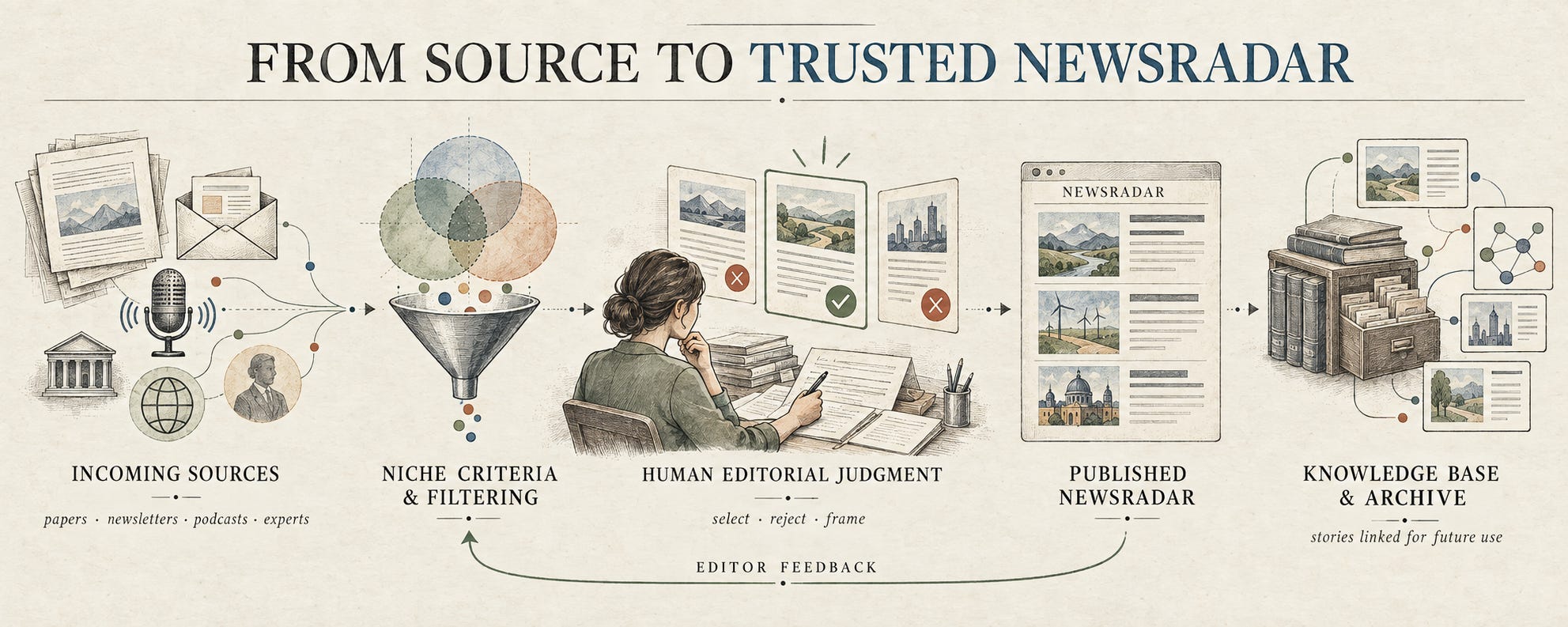
Here they are in detail:
Monitor a specific list of sources, potentially including:
Authors, experts, opinionists, curators, analysts, journalists
Newsletters + Curated news aggregators in their specific sectors: e.g.: AlignedNews, Techmeme, Hackernews, Smartbrief, NotaNewsletter (RIP)
Podcasts + Youtube channels
Academic Research papers (coming soon)
Second brains, Knowledge repositories, Digital gardens:
e.g.: Glasp, Sublime, Capacities, Obsidian, etc. (coming soon).
Capture
when stories from those sources match my specified cross-topic domain focus, capture them and place them in my editor inbox for vetting/approval.
allow me also to manually capture news / stories I run into with a custom-developed browser extension
.
Filter at a specified cross-domain intersection point: e.g.: where AI crosses interior design architecture for a professional in South East Asia. In my case for example: where credibility, authority and trust meet business entrepreneurship for indie experts, journalists and consultants.
The filtering is based on your defined criteria
What passes the filters is submitted to you for deep vetting and curation
As you select and exclude candidate stories the filter learns and refines its sensitivity for what matters.
.
Distill / Curate
Provide me with an editor inbox in which I can frame with a custom title the news / story for my specific audience and focus, and I can add a personal note explaining why that content is worth paying attention to.
.
Publish and Distribute
One-click publishing to my public newsradar page
.
Connect with the Rest
Finding and referencing next to each curated news story:
Relevant articles from my archive
News stories already published
My knowledgebase
Other basic features
Crediting / Attributing original author and publication
Preserving rejected stories and archiving the reason why
Archiving / organizing past news into a public archive
Sharing - each curated story has its own URL
.
Auto-feeding the curated stories into my knowledge base
Auto-feeding my curated stories into my draft Substack Notes inside Writestack
Here’s What Came Out of It
I now have a working newsradar engine that does 98% of the above.
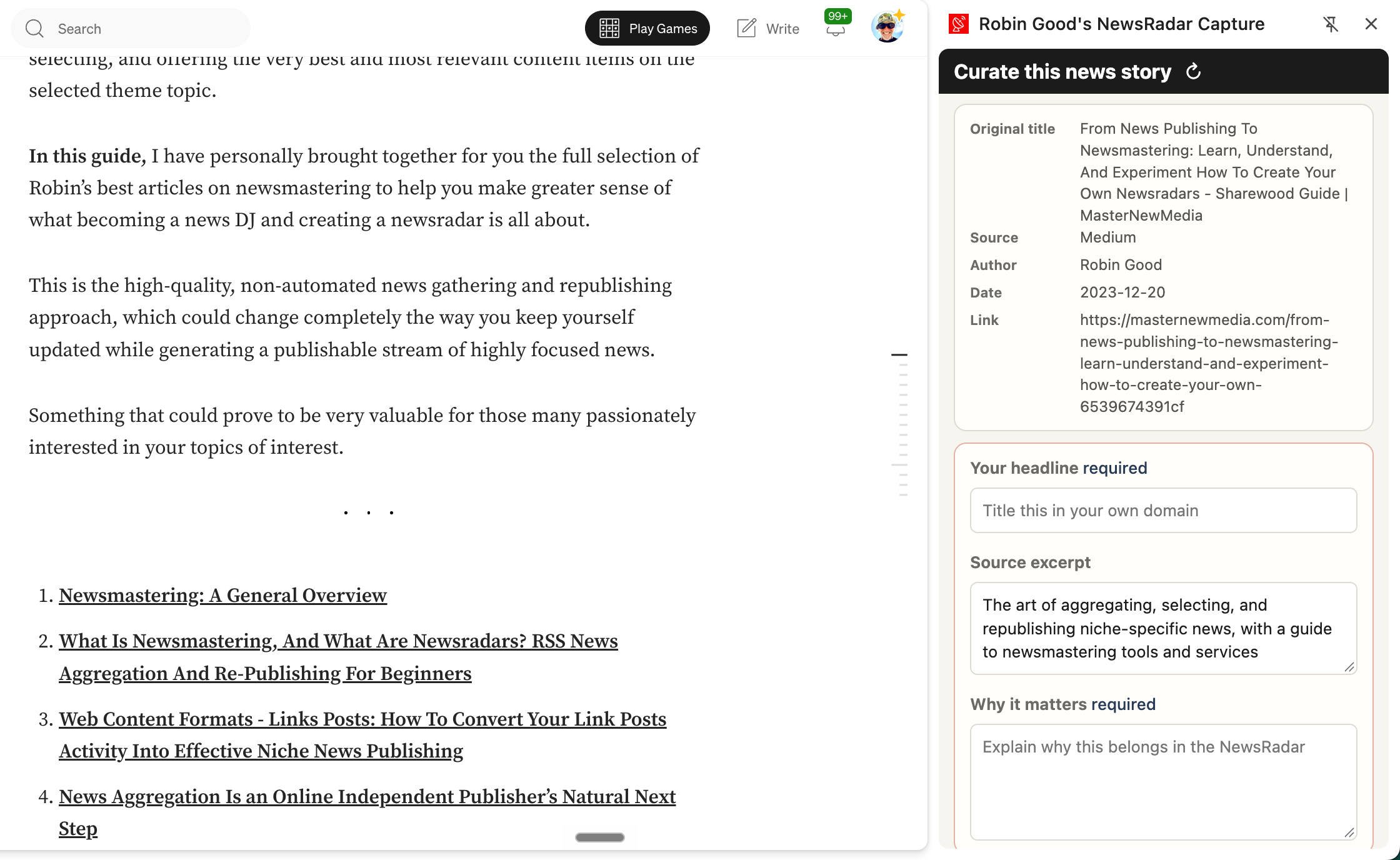
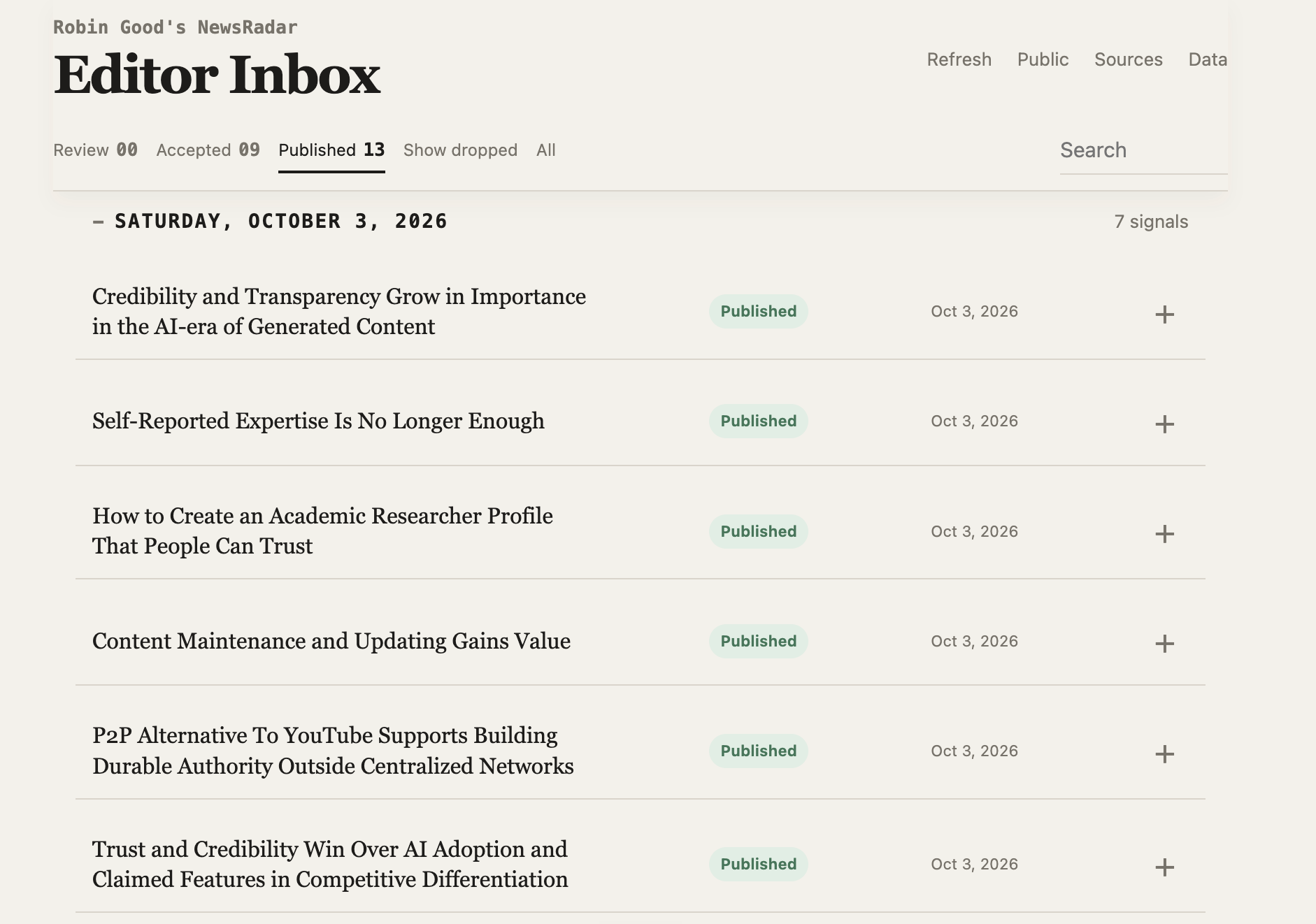
Anytime I read or run into an interesting story for my readers, I can click my custom extension, and curate it right there and then. Once saved, the story goes to my Editor Inbox for final approval, editing and review.
The system also prompts me once a day with whatever new interesting stories it has found on its own.
Here a few screenshots from the Chrome extension, Editor Inbox and the public newsradar page.
a. Newsradar Chrome extension
b. Editor Inbox
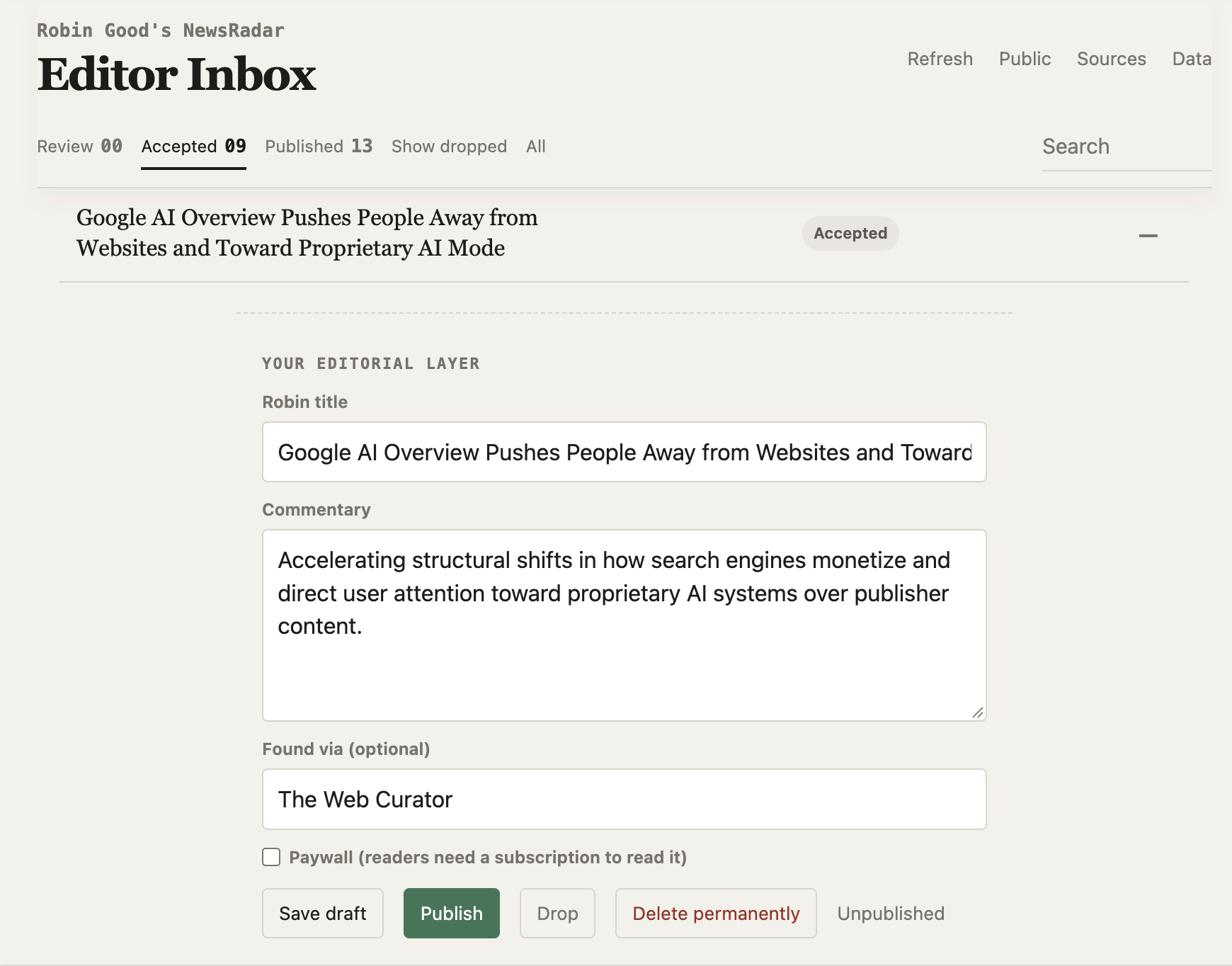
c. Public Newsradar

A Few Recommendations To Someone Building a Newsradar
Having a good selection of sources is essential.
Tip: Consider letting AI scan your inbox to identify all the sources and people that over the years have sent you relevant info on your topics of interest.
Filtering criteria are critical and it is a good idea to make them public. The more transparency about how you do what you do, the more credible you look in the eyes of your prospective client.
Selecting what to publish is obviously important, but “framing” is everything. How you interpret the story, what value you see in it for those who you serve, is where your true value contribution is born. Without framing and interpretation you’re just passing the dishes.
Information design is a key critical element in news publishing. A clean essential layout, easy to scan, legible, clearly distinguishing interpretation from reference, and letting sources and author prime visibility is something you have to design and request, not something AI or any classic news template easily provides.
Key Benefits of Curating a NewsRadar for Experts
A newsradar, a curated, topic-specific news channel maintained by a human expert, delivers ten distinct professional and business benefits to the curator, from trust-building to lead generation and revenue opportunity.
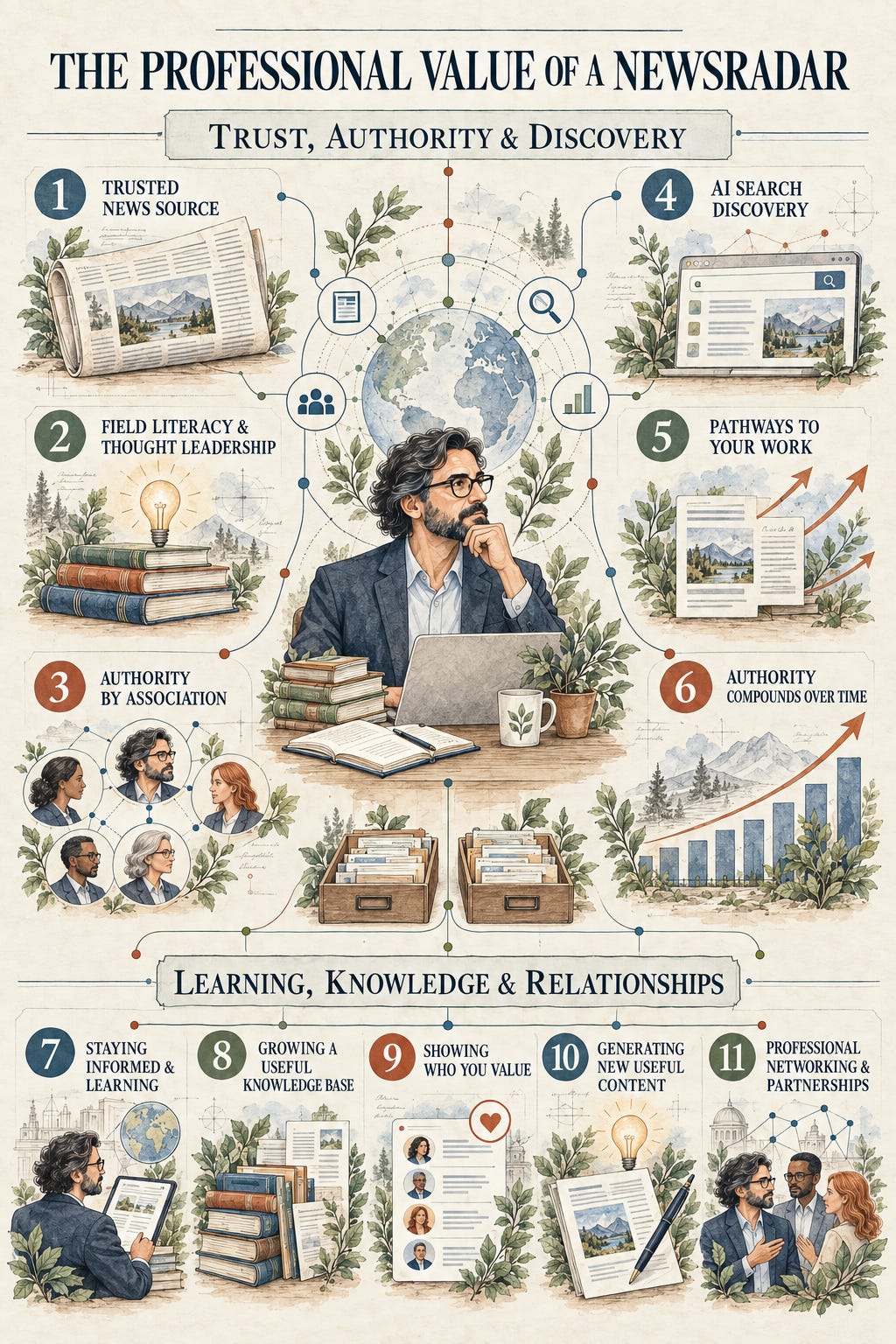
1. Establishing Yourself as a Trusted News Source
Consistent, high-quality curation positions you as a reliable guide readers can depend on. Over time, your newsradar becomes the “go-to” resource in your niche by providing an authored and verifiable one-stop information source. Readers perceive you not as someone selling expertise, but as a meta-curator, someone genuinely interested in keeping the field transparent and current.
2. Demonstrating Thought Leadership Through Field Literacy
Curating a newsradar proves you read widely, understand context, and can distinguish signal from noise. The ability to identify what matters and why it matters, signals deep competence. Readers can infer that if you can spot important news and trends before others, you likely understand the field’s trajectory better than most.
3. Building Authority by Association with Credible Sources
By consistently highlighting work from recognized experts, researchers, and institutions, you align yourself with credibility. The sources you cite and the patterns you identify reflect your judgment. Over time, your newsradar becomes a network of credible voices, and you occupy the center of that network.
4. Creating Visibility to AI Search Engines and New Discovery Mechanisms
AI-powered search engines (Perplexity, Bing Copilot, Claude) prefer curated resource collections with transparent selection criteria. A well-maintained newsradar signals to semantic search that you are a authoritative, reliable reference source, increasing likelihood of citation and discovery through AI-mediated research flows.
5. Offering a New Door To Discover Your Main Content
The newsradar gives to its readers a reason to come back. You’re not just writing classical articles, opinion pieces or advice. You are monitoring and interpreting a space for your audience, systematically, reliably. The “related news and articles” section in each story in the newsradar adds an additional discovery door for your main content which gets promoted each time in a different way, depending on the news story it gets associated to.
6. Creating Durable, Compounding Authority Over Time
Unlike articles or social posts (which decay in relevance), a newsradar cumulative archive grows more valuable. The longer you maintain it, the more pattern-visible your judgment becomes. A five-year newsradar archive demonstrates sustained field literacy that no single piece of content can match. Authority compounds.
7. Keeping Yourself Informed While Learning
The curation process forces you to interact, evaluate and extract insights and interpretation from the news you decide to curate. Good exercise for any thinking brain in the age of AI.
8. Growing a Useful Knowledge Base
When you publish a newsradar and connect it to your knowledge base, you begin building a resource you can often return to for new ideas. The newsradar keeps feeding your knowledge base with information that matters to you, while the reasoning you add helps you see how those pieces connect and makes your resource more valuable over time.
9. Showing Who You Value
Your newsradar shows people which sources you value. The articles and voices you choose to include tell readers what you pay attention to, whose work you respect, and where you look for reliable information. Over time, these choices give your Newsradar a character of its own. They also help others understand the standards behind what you share with them, and why.
10. Generating New Useful Content
Your Newsradar can help you create fresh, relevant content. The stories you select give you material to share in other places, such as Substack Notes or your social channels. You can add thoughts, connect a news story you curate in your newsradar to something you have written. This way, your news curation supports your knowledge base and publishing work.
11. Generating High-Value Professional Networking and Partnerships
Maintaining a newsradar means discovering and becoming visible to key thought leaders, researchers, and potential collaborators in your field. A newsradar curated over extended periods of time may allow you to become a node connecting these individuals. Experts notice when their work is consistently cited and sometimes relationships deepen through shared recognition. This creates opportunities for interviews, co-creation, and constructive partnerships and collaborations.
Tip
The best editorial strategy for a newsradar may not always be in curating the news of the area you know most. In many businesses what you know most, is not what your readers or prospective clients may want to know more about initially. You may know a lot about the solution, but your prospective customers - who don’t even know that a solution exists - seek info on their problem, interest or need first.
For example if you help companies train their AIs by first architecting their ontologies and knowledge bases, instead of making a curated newsradar on building ontologies and kbs, you do one around the problem they are seeing: training AIs. Methods, tech, stories, products around that very topic.
If you would like to publish your own focus-specific newsradar, I can assist you both in re-creating my own infrastructure as well as in learning how to best curate it to build your visibility, credibility and authority online.
Background Info on Newsradars
I have been thinking, writing and working with newsradars since 2004.
I spent so much energy on them because I honestly believe that they can be a great information resource, experts can provide to their readers, while tangibly qualifying their competence and expertise.
Over the years, whenever it was possible, I supported people and companies working to build tools that served those who wanted to curate a news feed. I clearly remember the early pioneers: BlogBridge (2004) built by Pito Salas, Giovanni Guardalben’s MySyndicaat (2005), and Guillaume De Cugis’ Scoop.it (2010), which is still alive and running today.


I used extensively all of these systems always providing feedback on what I saw was missing or deserving further attention.
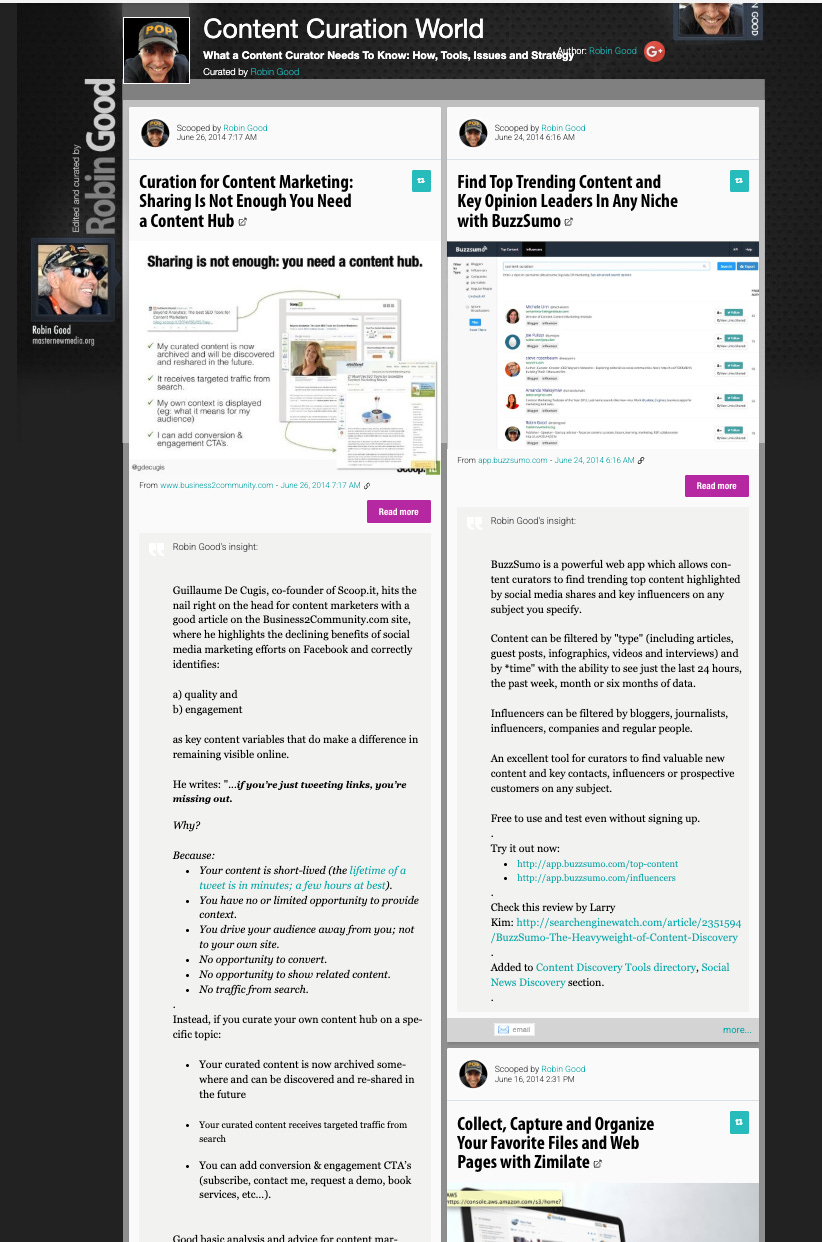
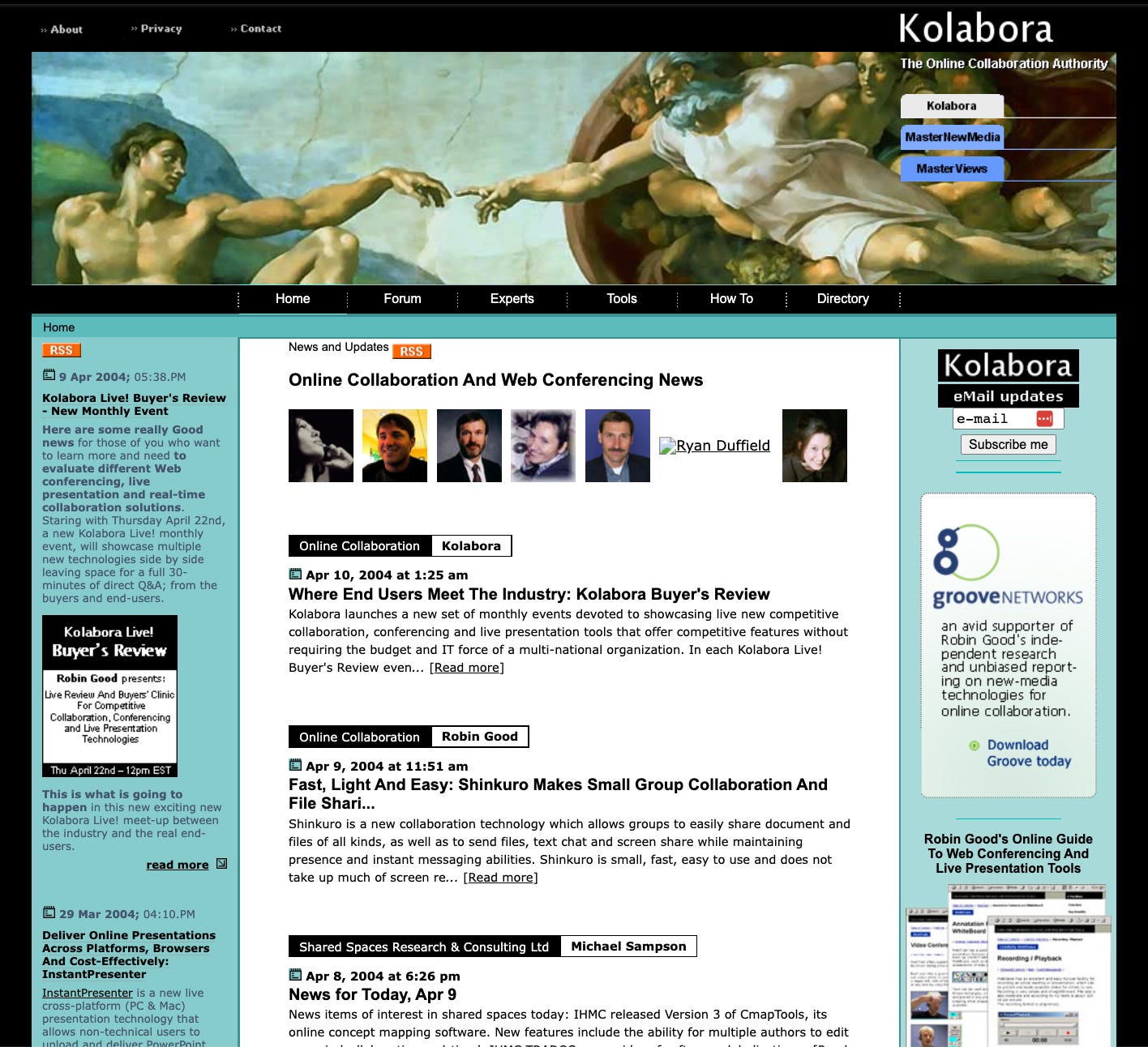
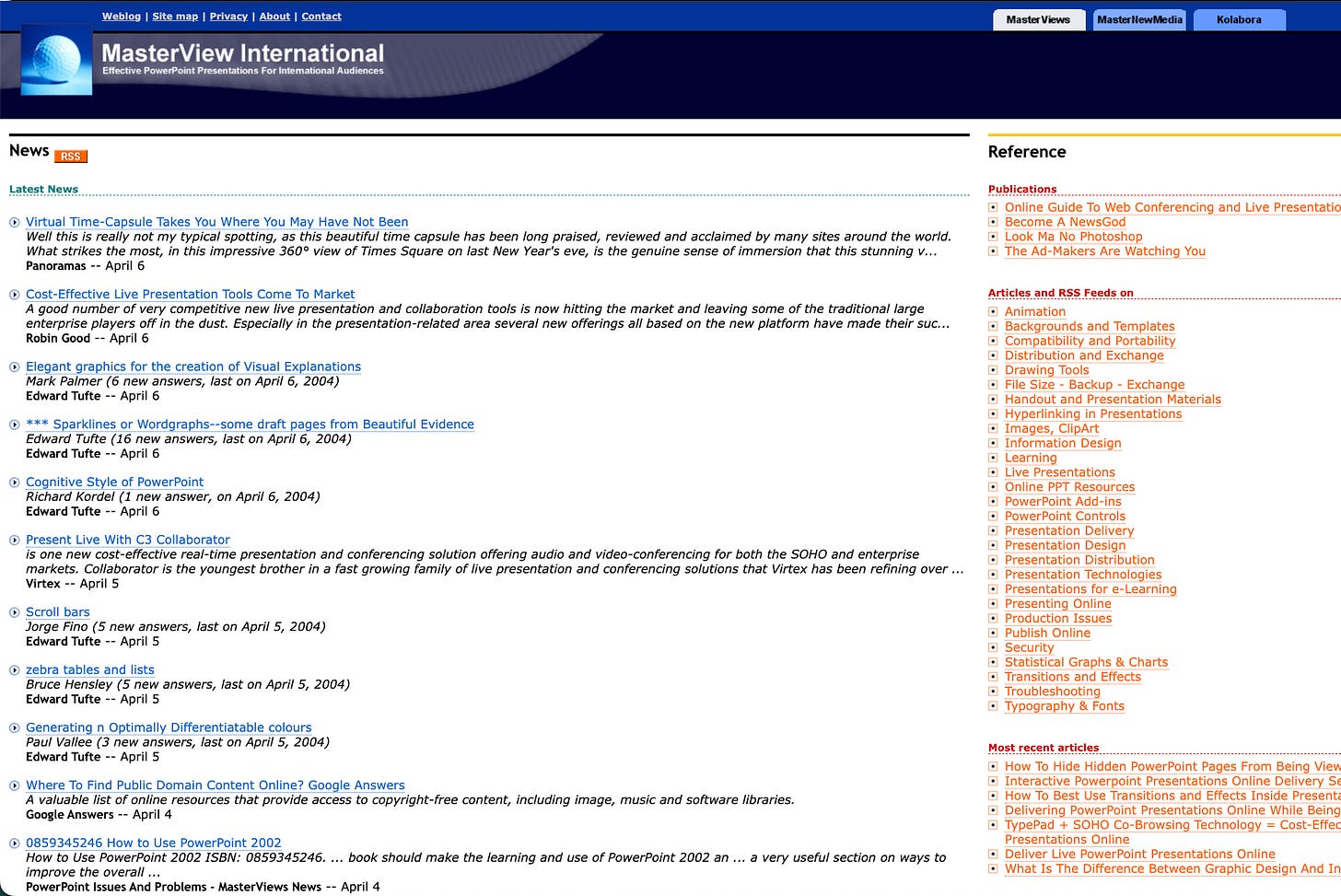
I myself have maintained over the years a few curated newsradars. Here the main ones:
Content Curation World - What a Content Curator Needs To Know
2011-2014

Focus: Online collaboration news and tools
2004-2015

Focus: Presentation tools and methods
2004-2008

2013-2020

How It Connects To the Rest
The story of why and how I built a newsradar engine connects strongly to a few specific articles I have written in the remote and recent past.
If you found the content of this story interesting and like the concept of a newsradar, I suggest checking out these other articles:


Building authority and credibility when you have a lot of experience.

Seven articles about news curation I first published in 2010’s.
Mini-Glossary
Newsmastering: The art and discipline of curating a newsradar. News curation.
Newsradar: The published output of a newsmaster work: a topic-specific curated news feed covering a specific mix of interests for a well-defined audience / need (tribe).
Newsmaster: A news curator: a subject matter expert who finds sources, monitors them, picks and selects, frames and interprets what matters for a specific audience.
Paradata
Why / Intent:
I wrote this article to document my first attempt at building a full-featured newsradar engine, a tool one can use (and help others re-create) to publicly curate the most relevant news at the intersection of a well-defined set of interest areas.
Process:
I first decided what tool to build, and that while I was building it, I would be writing the story of what I did.
Once I decided to build a newsradar engine and an associated public newsradar, I chose ChatGPT - Codex 5.6 Sol High as my vibe coding engine. I provided all of the specifications of the functionalities I wanted and links to existing and past examples.
I first built the scouting-gathering engine which checks a selected mix of sources and vets against a solid set of basic criteria I have established and made public. Whatever passes my filters, gets into my Editor Inbox in which I can review, drop, approve, edit / curate and publish any news story.
I then built the Chrome extension and the public newsradar page.
For the article side I initially I thought of telling through my voice the story of this article to an AI so that it could write it down in good form, saving me a lot of time and effort. And so I did. Nonetheless I used ChatGPT Astra 6, which has my full voiceprint, rules and context, what came out had nothing wrong with it… it didn’t read like slop, didn’t feel too polished or alien. It was just flat. Empty. Soulless. The most boring thing I have ever read.
That motivated me to sit back again at the steering wheel and to write from scratch, entirely by hand, the whole content of this article.
Times:
Trustable Article
Topic identification: 1 hr
Research: 2 hrs
Hand-writing of article: 5 hrs
Revisions and corrections: 0.5 hrs
Formatting and links: 1.5 hrs
Cover design: 1.5 hrs
Illustrations: 2 hrs
Total apx time: 13.5 hrs
.Newsradar Engine and Public Page
Planning: 1 hr
Gathering engine: 2 hrs
Chrome extension capture: 1.5 hr
Editorial Inbox and Management Tools: 3.5 hrs
Public Newsradar page: 3 hrs
Total apx time: 11 hrs
Tools:
ChatGPT 6 Luna High for brainstorming, planning, coding, UI design and both internal images and cover illustration.
MyCurator - personal knowledge base - a) for extracting criteria, insights, concepts that I have already written about in the past, b) for ingesting and distilling into a separate archive all of the news stories I am curating with the newsradar.

Cover image: A newsmaster curating her topic-specific newsradar. Concept by Robin Good. Image generation by ChatGPT Image 2.5.
What I Offer
I help experienced independent consultants, advisors and small expert-led firms that already deliver valuable work, but whose online presence fails to show why their expertise is different and worth paying for.
The Curation-Based Authority System (free)
55 minute video workshop illustrating how to build authority and credibility by creating high-value curated content formats, rather than original essays..
Make Your Expertise Buyable
private credibility and authority audit to help you show others how you differ and why your expertise is so valuable.
Trust Grader (free)
Paste the address of your personal website and see how credible it looks to a stranger. A score out of 100 in about two minutes, and what to fix first.
Follow a path with a heart.

From Koh Samui (TH)
Robin Good
This might be the most useful set of ideas I’ve seen on starting up a business/newsletter/personal brand. You’ve given me a lot to think about on having a greater focus for curating ideas to write about. And then to tie back to the work you do, genius.
"Robin, you've named the quiet work: not adding more, but finding what deserves attention — and trusting it enough to explain why. That's what 'Raha' tries to be: a newsradar for quiet. Thank you for this